Investigation of efflux pumps and biofilm formation in Escherichia coli isolated from various clinical sources in Baghdad, Iraq
DOI:
https://doi.org/10.69923/vz9kmf92Keywords:
Escherichia coli, Efflux pump, Biofilm, Phenotypic detectionAbstract
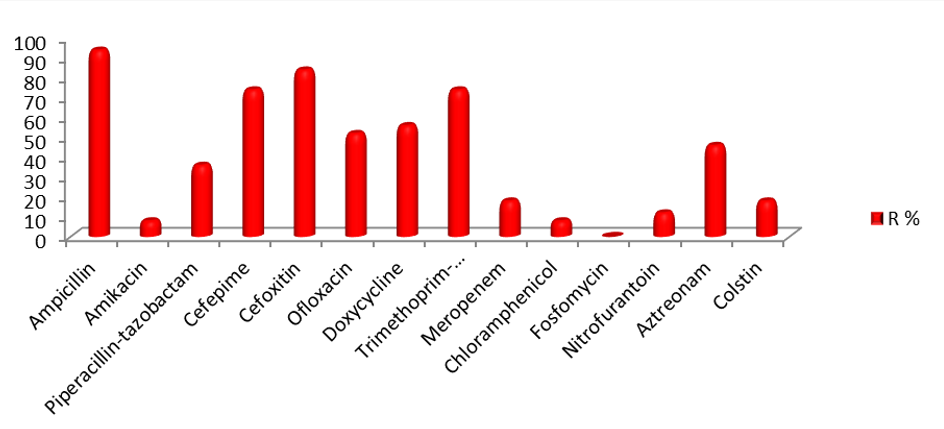
The rapid emergence of antibiotic-resistant Escherichia coli poses a major global health challenge, particularly in clinical settings where infections are common and increasingly difficult to treat. Among the principal mechanisms contributing to antimicrobial resistance are efflux pumps, which reduce intracellular antibiotic concentrations, and biofilm formation, a structured survival strategy that promotes bacterial persistence and decreases susceptibility to antimicrobial agents. This study aimed to phenotypically detect efflux pump activity and biofilm formation in E. coli isolates obtained from various clinical sources in Baghdad, Iraq, and to evaluate their contribution to multidrug resistance and their association with antimicrobial susceptibility patterns. A total of 305 clinical specimens were collected from patients with urinary tract infections, diarrhea, bloodstream infections, wounds, burns, and respiratory tract infections. Fifty E. coli isolates were identified using conventional microbiological methods and the VITEK 2 automated system. Antimicrobial susceptibility testing was performed against 13 commonly used antibiotics using the disk diffusion method, and the minimum inhibitory concentration (MIC) of colistin was determined. Based on their resistance profiles, 24 multidrug-resistant isolates were selected for further phenotypic analysis. High resistance rates were observed for ampicillin (94%) and cefoxitin (84%), whereas fosfomycin demonstrated complete effectiveness against urinary isolates. Among the multidrug-resistant isolates, 79.1% exhibited biofilm-forming ability, classified as strong (20.8%), moderate (20.8%), and weak (37.5%). Furthermore, 95.8% of the isolates showed efflux pump activity. Both biofilm formation and efflux pump activity were strongly associated with resistance to β-lactams, tetracyclines, quinolones, and cephalosporins.
Downloads
References
[1] World Health Organization, Global Action Plan on Antimicrobial Resistance. Geneva, Switzerland: WHO, 2015.
[2] M. Kasanga, G. Kwenda, J. Wu, et al., "Antimicrobial resistance patterns and risk factors associated with ESBL-producing and MDR Escherichia coli in hospital and environmental settings in Lusaka, Zambia: Implications for One Health, antimicrobial stewardship and surveillance systems," Microorganisms, vol. 11, no. 8, p. 1951, 2023, doi: 10.3390/microorganisms11081951.
[3] Y. Liu, M. Zhu, X. Fu, et al., "Escherichia coli causing neonatal meningitis during 2001–2020: A study in eastern China," Int. J. Gen. Med., pp. 3007–3016, 2021, doi: 10.2147/ijgm.s317299.
[4] C. L. Ventola, "The antibiotic resistance crisis: Part 1: Causes and threats," P T, vol. 40, no. 4, pp. 277–283, 2015.
[5] R. Alenazy, "Drug efflux pump inhibitors: A promising approach to counter multidrug resistance in Gram-negative pathogens by targeting AcrB protein from AcrAB-TolC multidrug efflux pump from Escherichia coli," Biology, vol. 11, no. 9, p. 1328, 2022, doi: 10.3390/biology11091328.
[6] K. Nishino, S. Yamasaki, R. Nakashima, M. Zwama, and M. Hayashi-Nishino, "Function and inhibitory mechanisms of multidrug efflux pumps," Front. Microbiol., vol. 12, p. 737288, 2021, doi: 10.3389/fmicb.2021.737288.
[7] D. O. Serra and R. Hengge, "Bacterial multicellularity: The biology of Escherichia coli building large-scale biofilm communities," Annu. Rev. Microbiol., vol. 75, no. 1, pp. 269–290, 2021, doi: 10.1146/annurev-micro-031921-055801.
[8] V. Ballén, V. Cepas, C. Ratia, Y. Gabasa, and S. M. Soto, "Clinical Escherichia coli: From biofilm formation to new antibiofilm strategies," Microorganisms, vol. 10, no. 6, p. 1103, 2022, doi: 10.3390/microorganisms10061103.
[9] M. Tajbakhsh, M. M. Akhavan, F. Fallah, and A. Karimi, "A recombinant snake cathelicidin derivative peptide: Antibiofilm properties and expression in Escherichia coli," Biomolecules, vol. 8, no. 4, p. 118, 2018, doi: 10.3390/biom8040118.
[10] F. Poursina, S. Sepehrpour, and S. Mobasherizadeh, "Biofilm formation in nonmultidrug-resistant Escherichia coli isolated from patients with urinary tract infection in Isfahan, Iran," Adv. Biomed. Res., vol. 7, no. 1, p. 40, 2018, doi: 10.4103/abr.abr_116_17.
[11] W. Levinson, P. Chin-Hong, E. A. Joyce, J. Nussbaum, and B. Schwartz, A Review of Medical Microbiology and Immunology: A Guide to Clinical Infectious Diseases, 15th ed. New York, NY, USA: McGraw-Hill Education, 2018.
[12] D. H. Pincus, Microbial Identification Using the Biomérieux Vitek®2 System. Hazelwood, MO, USA: bioMérieux, 2011, pp. 1–32.
[13] A. N. Schuetz, A. Ferrell, J. A. Hindler, R. Humphries, and A. M. Bobenchik, “Overview of changes in the Clinical and Laboratory Standards Institute Performance Standards for Antimicrobial Susceptibility Testing: M100 32nd and 33rd editions,” Journal of Clinical Microbiology, vol. 63, no. 9, Art. no. e01623-23, 2025, doi: 10.1128/JCM.01623-23.
[14] R. E. W. Hancock, "MIC determination by microtitre broth dilution method," Hancock Laboratory Methods, Department of Microbiology and Immunology, University of British Columbia, British Columbia, Canada, J. Bacteriol., Jan. 1999.
[15] R. Shrestha, S. Khanal, P. Poudel, et al., "Extended spectrum β-lactamase producing uropathogenic Escherichia coli and the correlation of biofilm with antibiotics resistance in Nepal," Ann. Clin. Microbiol. Antimicrob., vol. 18, pp. 1–6, 2019, doi: 10.1186/s12941-019-0340-y.
[16] M. Martins, M. P. McCusker, M. Viveiros, et al., "A simple method for assessment of MDR bacteria for over-expressed efflux pumps," Open Microbiol. J., vol. 7, p. 72, 2013, doi: 10.2174/1874285801307010072.
[17] G. Y. Worku, Y. B. Alamneh, and W. Erku Abegaz, "Prevalence of bacterial urinary tract infection and antimicrobial susceptibility patterns among diabetes mellitus patients attending Zewditu memorial hospital, Addis Ababa, Ethiopia," Infect. Drug Resist., pp. 1441–1454, 2021, doi: 10.2147/IDR.S298176.
[18] Z. M. Al-Shuwaiykh, Antibiotics and Their Uses. Amman, Jordan: Dar Al-Nashr, 2016, p. 112.
[19] S. B. Alrifai, A. Alsaadi, Y. A. Mahmood, A. A. Ali, and L. A. Al-Kaisi, "Prevalence and etiology of nosocomial diarrhoea in children <5 years in Tikrit teaching hospital," East Mediterr. Health J., vol. 15, no. 5, pp. 1111–1118, 2009, doi: 10.26719/2009.15.5.1111.
[20] R. Hateet, "Isolation and identification of some bacteria contaminating burn wounds in Misan, Iraq," Arch. Razi Inst., vol. 76, no. 6, pp. 1665–1670, 2021.
[21] H. F. Hassan, S. K. Jameel, and F. A. A. M. Ai-Khayat, "Bacterial infections of bloodstream and antimicrobial sensitivity test of neonate and adult Iraqi patients," Res. J. Pharm. Biol. Chem. Sci., vol. 9, no. 5, pp. 29–35, 2018.
[22] B. R. Raghubanshi and B. M. S. Karki, "Bacteriology of sputum samples: A descriptive cross-sectional study in a tertiary care hospital," JNMA J. Nepal Med. Assoc., vol. 58, no. 221, pp. 24–28, 2020, doi: 10.31729/jnma.4807.
[23] M. H. Halah, S. A. Dalal, A. Al-Rubaye, and A. Abdelhameed, "The emergence of multidrug-resistant (MDR), extensively drug-resistant (XDR), and pandrug-resistant (PDR) in Iraqi clinical isolates of Escherichia coli," J. Popul. Ther. Clin. Pharmacol., vol. 30, p. 469, 2023, doi: 10.47750/jptcp.2023.30.05.047.
[24] D. Das, P. Vohra, P. Mane, and C. K. Shaozae, "Extended spectrum, AmpC & metallo β-lactamases producing Escherichia coli in urinary isolates: A prospective study in north India," Indian J. Med. Res., vol. 161, no. 2, p. 167, 2025, doi: 10.25259/ijmr_153_2024.
[25] R. F. Polse, S. Y. Yousif, and M. S. Assafi, "Prevalence and antimicrobial susceptibility patterns of uropathogenic E. coli among people in Zakho, Iraq," Int. J. Res. Med. Sci., vol. 4, no. 4, pp. 1219–1223, 2016, doi: 10.18203/2320-6012.IJRMS20160813.
[26] A. Govindaswamy, V. Bajpai, S. Khurana, et al., "Prevalence and characterization of beta-lactamase-producing Escherichia coli isolates from a tertiary care hospital in India," J. Lab. Physicians, vol. 11, no. 2, pp. 123–127, 2019, doi: 10.4103/jlp.jlp_122_18.
[27] E. S. A. A. K. Al-Haddad, "Study of some genotypes of E. coli isolates causing urinary tract infections and their relation to antibiotic resistance in Al-Najaf Al-Ashraf hospitals," M.Sc. thesis, College of Education for Girls, University of Kufa, 2021.
[28] A. L. Santos, A. P. Dos Santos, C. R. M. Ito, et al., "Profile of enterobacteria resistant to beta-lactams," Antibiotics, vol. 9, no. 7, p. 410, 2020, doi: 10.3390/antibiotics9070410.
[29] R. Ghotaslou, S. Baghbani, P. Ghotaslou, S. Mirmahdavi, and H. E. Leylabadlo, "Molecular epidemiology of antibiotic-resistant Escherichia coli among clinical samples isolated in Azerbaijan, Iran," Iran. J. Microbiol., vol. 15, no. 3, p. 383, 2023, doi: 10.18502/ijm.v15i3.12898.
[30] M. Garousi, S. M. Tabar, H. Mirazi, et al., "A global systematic review and meta-analysis on correlation between biofilm producers and non-biofilm producers with antibiotic resistance in uropathogenic Escherichia coli," Microb. Pathog., vol. 164, p. 105412, 2022, doi: 10.1016/j.micpath.2022.105412.
[31] M. Abavisani, N. Bostanghadiri, H. Ghahramanpour, et al., "Colistin resistance mechanisms in Gram-negative bacteria: A focus on Escherichia coli," Lett. Appl. Microbiol., vol. 76, no. 2, p. ovad023, 2023, doi: 10.1093/lambio/ovad023.
[32] A. A. Aqel, T. M. Al-Matarneh, T. K. Al-Tarawneh, T. Alnawayseh, M. Alsbou, and Y. Gaber, "Monitoring of antibiotic resistance patterns within Al-Karak Governmental Hospital, Jordan, in 2022," Antibiotics, vol. 13, no. 12, p. 1172, 2024, doi: 10.3390/antibiotics13121172.
[33] H. A. S. Al-Hadidi, "Prevalence and toxic effects of Cytotoxic Necrotizing Factor and Coli Actin genes among uropathogenic Escherichia coli isolates from Iraqi patients," M.Sc. thesis, College of Science for Women, University of Baghdad, 2021.
[34] H. H. L. Le, L. C. Thuc, T. B. Ta, et al., "Prevailing antibiotic resistance patterns in hospitalized patients with urinary tract infections in a Vietnamese teaching hospital (2014–2021)," Infect. Drug Resist., pp. 613–623, 2025, doi: 10.2147/idr.s499804.
[35] J. Ali, Q. A. Rafiq, and E. Ratcliffe, "Antimicrobial resistance mechanisms and potential synthetic treatments," Future Sci. OA, vol. 4, no. 4, p. FSO290, 2018, doi: 10.4155/fsoa-2017-0109.
[36] A. Pormohammad, S. Ghorbani, B. Baradaran, et al., "Clinical characteristics, laboratory findings, radiographic signs and outcomes of 61,742 patients with confirmed COVID-19 infection: A systematic review and meta-analysis," Microb. Pathog., vol. 147, p. 104390, 2020, doi: 10.1016/j.micpath.2020.104390.
[37] I. A. Naqid, A. A. Balatay, N. R. Hussein, K. A. Saeed, H. A. Ahmed, and S. H. Yousif, "Antibiotic susceptibility pattern of Escherichia coli isolated from various clinical samples in Duhok City, Kurdistan Region of Iraq," Int. J. Infect., vol. 7, no. 3, 2020, doi: 10.5812/iji.103740.
[38] R. Kadhim Mohammed, "Investigation of the role of virulence gene in biofilm formation of Escherichia coli obtained from clinical specimens in Baghdad," Arch. Razi Inst., vol. 77, no. 2, pp. 915–921, 2022, doi: 10.22092/ari.2022.357205.1995.
[39] F. Poursina, S. Sepehrpour, and S. Mobasherizadeh, "Biofilm formation in nonmultidrug-resistant Escherichia coli isolated from patients with urinary tract infection in Isfahan, Iran," Adv. Biomed. Res., vol. 7, no. 1, p. 40, 2018, doi: 10.4103/abr.abr_116_17.
[40] S. A. A. Hamid and R. M. Khoshabeh, "Antibiotic resistance, biofilm formation, and identification of FimH and FimA adhesion genes in uropathogenic Escherichia coli (UPEC) isolated from patients in Baghdad Province," Iraqi J. Sci., pp. 5546–5554, 2024, doi: 10.24996/ijs.2024.65.10.19.
[41] D. Abo-Alella, W. Abdelmoniem, E. Tantawy, and A. Asaad, "Biofilm-producing and carbapenems-resistant Escherichia coli nosocomial uropathogens: A cross-sectional study," Int. Microbiol., pp. 1–8, 2024, doi: 10.1007/s10123-024-00495-w.
[42] M. Garousi, S. M. Tabar, H. Mirazi, et al., "A global systematic review and meta-analysis on correlation between biofilm producers and non-biofilm producers with antibiotic resistance in uropathogenic Escherichia coli," Microb. Pathog., vol. 164, p. 105412, 2022, doi: 10.1016/j.micpath.2022.105412.
[43] H. J. Ibrahim and S. J. J. Al-Zubaidi, "Molecular detection of some efflux pumps genes in Escherichia coli isolated from patients with urinary tract infections in Baqubah City, Iraq," Egypt. J. Hosp. Med., vol. 90, no. 2, pp. 3395–3401, 2023.
[44] B. L. Smith, S. Fernando, and M. D. King, "Escherichia coli resistance mechanism AcrAB-TolC efflux pump interactions with commonly used antibiotics: A molecular dynamics study," Sci. Rep., vol. 14, no. 1, p. 2742, 2024, doi: 10.1038/s41598-024-52536-z.
Downloads
Published
Issue
Section
License
Copyright (c) 2026 Iraqi Journal for Applied Science

This work is licensed under a Creative Commons Attribution 4.0 International License.
Licenses and Copyright
The copyright of this article is retained by the author(s).
This article is published by the Iraqi Journal for Applied Science (IJAS) under the Creative Commons Attribution 4.0 International License (CC BY 4.0).
This license permits unrestricted use, distribution, reproduction, adaptation, and reuse of the work in any medium or format, including commercial use, provided that appropriate credit is given to the original author(s) and the source, a link to the license is provided, and any modifications are indicated.
Authors retain full copyright of their work and grant IJAS a non-exclusive license to publish, archive, preserve, and disseminate the article, including registration of metadata and Digital Object Identifiers (DOIs) through Crossref.
Any third-party material included in this article remains subject to its respective copyright and licensing conditions. Authors are responsible for obtaining all necessary permissions for such material before publication.
For complete details regarding copyright, licensing, permissions, and reuse, please refer to the journal's Copyright and Licensing Policy available on the IJAS website.
License: https://creativecommons.org/licenses/by/4.0/
How to Cite