Adsorption of chromium ions using two types of aqueous biochar
DOI:
https://doi.org/10.69923/2nrc6545Keywords:
Biochar, adsorption, Chromium ions Cr(VI).Abstract
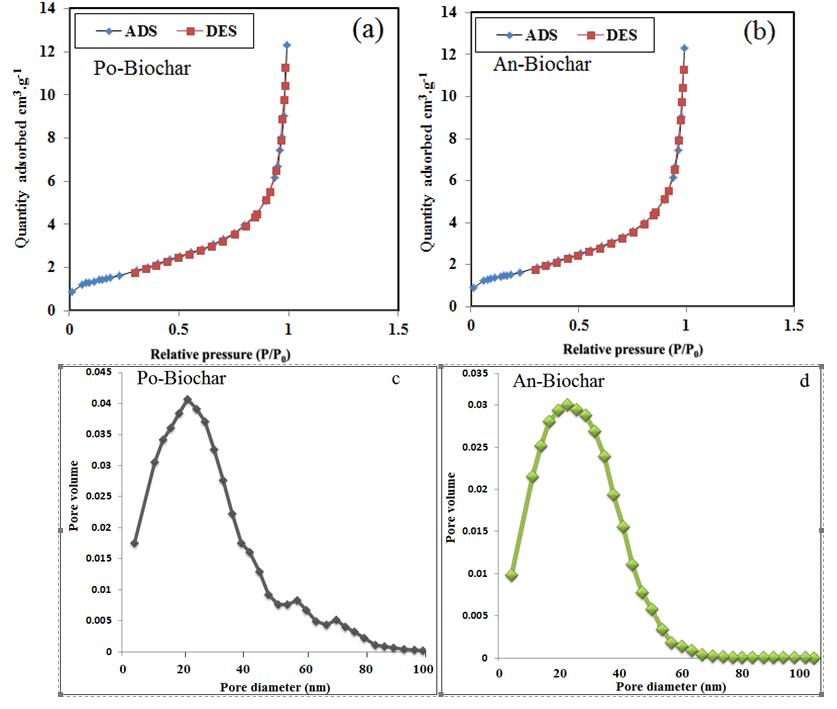
Biochar is a porous, carbon-rich substance created when biomass is thermally broken down in an oxygen-limited environment. The removal of chromium ions from polluted water has been extensively investigated because of its large surface area and surface functional groups. This study observes the production of biochar from a variety of biomass sources, such as Pomegranate husks (Po-Biochar) and animal waste (An-Biochar), and assesses how well these methods remove Cr(VI) from aqueous solutions. FTIR, FE-SEM, and BET were used to describe the biochar samples. The effects of pH, contact duration, Cr(VI) concentration, and biochar dose were evaluated using adsorption studies. According to the data, An-Biochar exhibited the maximum adsorption capacity. The adsorption process also followed pseudo-second-order kinetics, and the Freundlich isotherm was found to be the best one that can describe the adsorption of chromium ions Cr(VI) over Po-Biochar and An-Biochar samples, compared with the Langmuir isotherm, all of which were noted from the correlation coefficient values R2.
Downloads
References
[1] E. Kingsley et al., "Effect of hexavalent chromium on the environment and removal techniques: A review," J. Environ. Manage., vol. 280, p. 111809, 2021, doi: 10.1016/j.jenvman.2020.111809.
[2] S. Pooja, P. Surendra, K. Sheetal, and W. Yen, "Health hazards of hexavalent chromium (Cr (VI)) and its microbial reduction," Bioengineered, vol. 13, no. 3, pp. 4923–4938, 2022, doi: 10.1080/21655979.2022.2037273.
[3] S. Ewa, J. Karolina, and P. Agnieszka, "Chromium (III) and chromium (VI) as important players in the induction of genotoxicity – current view," Ann. Agric. Environ. Med., vol. 28, no. 1, pp. 1-10, 2021, doi: 10.26444/aaem/118228.
[4] K. Aisha et al., "Hydrochar as a bio-based adsorbent for heavy metals removal: A review of production processes, adsorption mechanisms, kinetic models, regeneration and reusability," Sci. Total Environ., vol. 945, p. 173972, 2024, doi: 10.1016/j.scitotenv.2024.173972.
[5] A. Jose, F. Jose, C. Leonidas, R. Igor, and S. Teogenes, "Influence of pyrolysis temperature and feedstock on the properties of biochars produced from agricultural and industrial wastes," J. Anal. Appl. Pyrolysis, vol. 149, p. 104839, 2020, doi: 10.1016/j.jaap.2020.104839.
[6] A. Reyhanitabar, E. Farhadi, H. Ramezanzadeh, and S. Oustan, "Effect of pyrolysis temperature and feedstock sources on physicochemical characteristics of biochar," J. Agric. Sci. Technol., vol. 22, no. 2, pp. 547-561, 2020. doi:10.22092/ijsr.2021.353431.582.
[7] S. Saroop et al., "Analyzing the impacts of three types of biochar on soil carbon fractions and physiochemical properties in a corn-soybean rotation," Chemosphere, vol. 184, pp. 473-481, 2017, doi: 10.1016/j.chemosphere.2017.05.165.
[8] M. Yichuan, Z. Shuting, and W. Jianlong, "Adsorption of heavy metals by biochar in aqueous solution: A review," Sci. Total Environ., vol. 968, p. 178898, 2025, doi: 10.1016/j.scitotenv.2025.178898.
[9] W. Yizhuo, L. He, and L. Shaohua, "Advances in the study of heavy metal adsorption from water and soil by modified biochar," Water, vol. 14, no. 23, p. 3894, 2022, doi: 10.3390/w14233894.
[10] V. Maria, J. Joan, V. Mariano, C. Eva, D. Belen, and J. Francisco, "Influence of feedstock and final pyrolysis temperature on breaking strength and dust production of wood-derived biochars," Sustainability, vol. 13, no. 21, p. 11871, 2021, doi: 10.3390/su132111871.
[11] Y. Ahmed et al., "Effect of pyrolysis temperature on biochar microstructural evolution, physicochemical characteristics, and its influence on biochar/polypropylene composites," Appl. Sci., vol. 9, no. 6, p. 1149, 2019, doi: 10.3390/app9061149.
[12] R. Narzari, N. Bordoloi, B. Sarma, L. Gogoi, N. Gogoi, and B. Borkotoki, "Fabrication of biochars obtained from the valorization of biowaste and evaluation of its physicochemical properties," Bioresour. Technol., vol. 242, pp. 324–328, 2017, doi: 10.1016/j.biortech.2017.04.050.
[13] L. Yongliang, H. Zhongqi, and U. Minori, "Comparison of biochar formation from various agricultural by-products using FTIR spectroscopy," Mod. Appl. Sci., vol. 9, no. 4, 2015, doi: 10.5539/mas.v9n4p246.
[14] M. Muhajir, C. Yonas, and T. Beteley, "Kinetics, adsorption isotherms, thermodynamics, and desorption studies of cadmium removal from aqueous solutions using bamboo sawdust/rice husk biochar," Biomass Convers. Biorefin., 2022, doi: 10.1007/s13399-022-03472-3.
[15] T. Prasetyo et al., "Adsorption isotherm model of Hg2+ with biochar from young coconut waste," IOP Conf. Ser.: Earth Environ. Sci., vol. 1297, p. 012093, 2024, doi: 10.1088/1755-1315/1297/1/012093.
Downloads
Published
Issue
Section
License
Copyright (c) 2026 Iraqi Journal for Applied Science

This work is licensed under a Creative Commons Attribution 4.0 International License.
Licenses and Copyright
The copyright of this article is retained by the author(s).
This article is published by the Iraqi Journal for Applied Science (IJAS) under the Creative Commons Attribution 4.0 International License (CC BY 4.0).
This license permits unrestricted use, distribution, reproduction, adaptation, and reuse of the work in any medium or format, including commercial use, provided that appropriate credit is given to the original author(s) and the source, a link to the license is provided, and any modifications are indicated.
Authors retain full copyright of their work and grant IJAS a non-exclusive license to publish, archive, preserve, and disseminate the article, including registration of metadata and Digital Object Identifiers (DOIs) through Crossref.
Any third-party material included in this article remains subject to its respective copyright and licensing conditions. Authors are responsible for obtaining all necessary permissions for such material before publication.
For complete details regarding copyright, licensing, permissions, and reuse, please refer to the journal's Copyright and Licensing Policy available on the IJAS website.
License: https://creativecommons.org/licenses/by/4.0/
How to Cite