A Comparative Systems Analysis of Non-Enzymatic Metabolism in Human and Bacterial Networks
DOI:
https://doi.org/10.69923/ap8k3x39Keywords:
Non-enzymatic metabolism, E. coli, Phenol Metabolism, Xenobiotic metabolism, urea cycle, oxidative phosphorylationAbstract
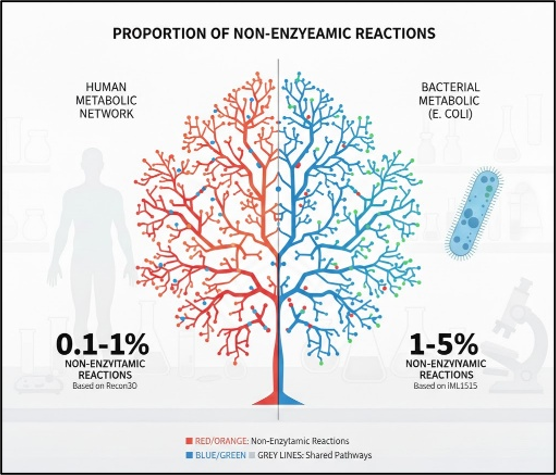
The metabolism is divided into two types: enzymatic and non-enzymatic. The non-enzymatic metabolism is a group of biochemical reactions that occur spontaneously or are catalyzed by small molecules or light and do not rely on enzymes for catalysis. This type of metabolism contributes to the formation of certain reactive metabolites, modifies proteins, and affects cell stability through chemical pathways independent of enzyme catalysis. Databases used in metabolic research can be classified into four main types: IBM SPSS version 25 for statistics, Recon 2.2, iML1515 as a database, KEGG and MetaCyc to understand metabolic pathways, and Colab Research for data charts. The metabolic networks in humans and E. coli are dominated by enzymatic reactions; the relative proportion of non-enzymatic reactions is higher in E. coli (≈1–5%) compared to humans (≈0.1–1%), reflecting the simplicity of cellular organization and the high influence of spontaneous chemistry in primitive systems. This study provides a preliminary quantitative estimate of the contribution of non-enzymatic interactions to reconstructed metabolic networks in humans and Escherichia coli. The results show that this contribution remains limited but tends to increase significantly in evolutionarily simpler systems. The study proposes a methodological framework that can serve as a basis for future research exploring the impact of these interactions on cellular metabolic dynamics. This study aims to conduct a comparative analysis of non-enzymatic interactions in human and bacterial metabolic networks, assessing their distribution within different metabolic systems, based on global metabolic databases such as Recon and KEGG.
Downloads
References
[1] C. G. J. A. i. m. p. Friedrich, "Physiology and genetics of sulfur-oxidizing bacteria," vol. 39, pp. 235-289, 1997, https://doi.org/10.1016/S0065-2911(08)60018-1.
[2] F. Sarmiento, R. Peralta, J. M. J. F. i. b. Blamey, and biotechnology, "Cold and hot extremozymes: industrial relevance and current trends," vol. 3, p. 148, 2015, https://doi.org/10.3389/fbioe.2015.00148.
[3] G. Cirino, C. Szabo, and A. J. P. r. Papapetropoulos, "Physiological roles of hydrogen sulfide in mammalian cells, tissues, and organs," vol. 103, no. 1, pp. 31-276, 2023, https://doi.org/10.1152/physrev.00028.2021.
[4] K. G. Fosnacht and M. D. J. C. r. Pluth, "Activity-based fluorescent probes for hydrogen sulfide and related reactive sulfur species," vol. 124, no. 7, pp. 4124-4257, 2024, https://doi.org/10.1021/acs.chemrev.3c00683.
[5] M. A. Keller, G. Piedrafita, and M. J. C. o. i. b. Ralser, "The widespread role of non-enzymatic reactions in cellular metabolism," vol. 34, pp. 153-161, 2015, https://doi.org/10.1016/j.copbio.2014.12.020.
[6] H. Sies, R. J. Mailloux, and U. J. N. R. M. C. B. Jakob, "Fundamentals of redox regulation in biology," vol. 25, no. 9, pp. 701-719, 2024, https://doi.org/10.1038/s41580-024-00730-2.
[7] B. Li et al., "Redox regulation: mechanisms, biology and therapeutic targets in diseases," vol. 10, no. 1, p. 72, 2025, https://doi.org/10.1038/s41392-024-02095-6.
[8] K. B. Muchowska, S. J. Varma, and J. J. C. R. Moran, "Nonenzymatic metabolic reactions and life’s origins," vol. 120, no. 15, pp. 7708-7744, 2020, https://doi.org/10.1021/acs.chemrev.0c00191.
[9] C. Francke, R. J. Siezen, and B. J. T. i. M. Teusink, "Reconstructing the metabolic network of a bacterium from its genome," vol. 11, no. 13, pp. 550-558, 2005, https://doi.org/10.1016/j.tim.2005.09.001.
[10] Z. Tian et al., "PMhub 1.0: a comprehensive plant metabolome database," vol. 52, no. D1, pp. D1579-D1587, 2024, https://doi.org/10.1093/nar/gkad811.
[11] I. Thiele et al., "A community-driven global reconstruction of human metabolism," vol. 31, no. 5, pp. 419-425, 2013, https://doi.org/10.1038/nbt.2488.
[12] J. M. Monk et al., "i ML1515, a knowledgebase that computes Escherichia coli traits," vol. 35, no. 10, pp. 904-908, 2017, https://doi.org/10.1038/nbt.3956.
[13] N. C. Duarte et al., "Global reconstruction of the human metabolic network based on genomic and bibliomic data," vol. 104, no. 6, pp. 1777-1782, 2007, https://doi.org/10.1073/pnas.0610772104.
[14] A. Drazic, E. Kutzner, J. Winter, and W. J. P. O. Eisenreich, "Metabolic response of Escherichia coli upon treatment with hypochlorite at sub-lethal concentrations," vol. 10, no. 5, p. e0125823, 2015, https://doi.org/10.1371/journal.pone.0125823.
[15] I. J. D. m. r. Hanukoglu, "Antioxidant protective mechanisms against reactive oxygen species (ROS) generated by mitochondrial P450 systems in steroidogenic cells," vol. 38, no. 1-2, pp. 171-196, 2006, https://doi.org/10.1080/03602530600570040.
[16] D. J. Müller, J. Helenius, D. Alsteens, and Y. F. J. N. c. b. Dufrêne, "Force probing surfaces of living cells to molecular resolution," vol. 5, no. 6, pp. 383-390, 2009, https://doi.org/10.1038/nchembio.181.
[17] A. Metwaly, S. Reitmeier, D. J. N. r. G. Haller, and hepatology, "Microbiome risk profiles as biomarkers for inflammatory and metabolic disorders," vol. 19, no. 6, pp. 383-397, 2022, https://doi.org/10.1038/s41575-022-00581-2.
[18] K. Andreau, M. Leroux, and A. J. B. r. i. Bouharrour, "Health and cellular impacts of air pollutants: from cytoprotection to cytotoxicity," vol. 2012, no. 1, p. 493894, 2012., https://doi.org/10.1155/2012/493894.
[19] S. Ahuja and S. J. I. Zaheer, "Molecular mediators of metabolic reprogramming in cancer: mechanisms, regulatory networks, and therapeutic strategies," 2025, https://doi.org/10.1111/imm.70045.
[20] P. Ashrap et al., "Discovery of a widespread metabolic pathway within and among phenolic xenobiotics," vol. 114, no. 23, pp. 6062-6067, 2017, https://doi.org/10.1073/pnas.1700558114.
[21] U. Asghar, A. K. Witkiewicz, N. C. Turner, and E. S. J. N. r. D. d. Knudsen, "The history and future of targeting cyclin-dependent kinases in cancer therapy," vol. 14, no. 2, pp. 130-146, 2015, https://doi.org/10.1038/nrd4504.
[22] M. Pósfai and A.-L. Barabási, Network science. Cambridge University Press, Cambridge, UK:, 2016, ISBN: 978-0-662-882-8-9 9781107076266.
[23] O. Folger, L. Jerby, C. Frezza, E. Gottlieb, E. Ruppin, and T. J. M. s. b. Shlomi, "Predicting selective drug targets in cancer through metabolic networks," vol. 7, no. 1, p. 501, 2011, https://doi.org/10.1038/msb201151.
[24] M. A. Keller, A. V. Turchyn, and M. J. M. s. b. Ralser, "Non‐enzymatic glycolysis and pentose phosphate pathway‐like reactions in a plausible Aschean ocean," vol. 10, no. 4, p. 725, 2014, https://doi.org/10.1002/msb.20145228.
Downloads
Published
License
Copyright (c) 2026 lubna alassaf (Author)

This work is licensed under a Creative Commons Attribution 4.0 International License.
Licenses and Copyright
The copyright of this article is retained by the author(s).
This article is published by the Iraqi Journal for Applied Science (IJAS) under the Creative Commons Attribution 4.0 International License (CC BY 4.0).
This license permits unrestricted use, distribution, reproduction, adaptation, and reuse of the work in any medium or format, including commercial use, provided that appropriate credit is given to the original author(s) and the source, a link to the license is provided, and any modifications are indicated.
Authors retain full copyright of their work and grant IJAS a non-exclusive license to publish, archive, preserve, and disseminate the article, including registration of metadata and Digital Object Identifiers (DOIs) through Crossref.
Any third-party material included in this article remains subject to its respective copyright and licensing conditions. Authors are responsible for obtaining all necessary permissions for such material before publication.
For complete details regarding copyright, licensing, permissions, and reuse, please refer to the journal's Copyright and Licensing Policy available on the IJAS website.
License: https://creativecommons.org/licenses/by/4.0/
How to Cite