The Role of IL-6 in the Relationship Between Peptic Ulcer Disease and Depression: A Case-Control Study
DOI:
https://doi.org/10.69923/cse2h072Keywords:
Peptic Ulcer Disease, Depression, IL-6, Gut-Brain Axis, PsychoneuroimmunologyAbstract
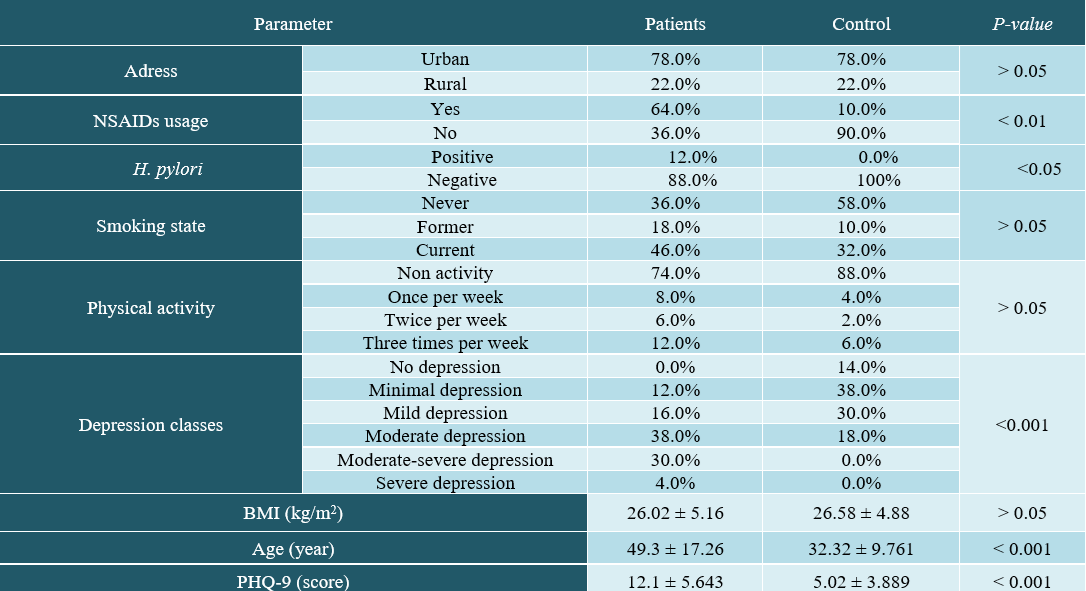
Peptic Ulcer Disease (PUD) is a localized gastrointestinal inflammatory disorder characterized by mucosal damage and is increasingly recognized as being influenced by both physiological and psychological stressors. Interleukin-6 (IL-6), a pleiotropic pro-inflammatory cytokine, serves as an important mediator of inflammatory responses and may contribute to the interaction between gastrointestinal and psychological disorders. This study aimed to investigate the relationship between PUD and depression by evaluating the role of IL-6 as a potential underlying inflammatory mechanism. A case-control study was conducted involving 50 patients diagnosed with peptic ulcer disease by endoscopy and 50 healthy control subjects. Depression was diagnosed by a clinical psychologist, and its severity was assessed using the Patient Health Questionnaire-9 (PHQ-9). Serum IL-6 levels were measured using enzyme-linked immunosorbent assay (ELISA). Statistical analyses were performed using Student’s t-test and one-way analysis of variance (ANOVA). The results showed that serum IL-6 levels were significantly higher in PUD patients than in healthy controls, increasing from 96.22 ± 16.16 pg/mL in the control group to 306.85 ± 39.28 pg/mL in the PUD group (p < 0.001). These findings indicate a strong association between PUD and systemic inflammation. Elevated serum IL-6 levels support its potential role as a key mediator in the gut–brain axis, linking gastrointestinal inflammation with psychological distress. Therefore, IL-6 may serve as a promising biomarker for understanding the inflammatory mechanisms underlying the association between peptic ulcer disease and depression.
Downloads
References
[1] Shukar Singh, Gursewak Singh, Tawqeer Shafi, and Shafkat Hussain Malik, “Overview of Peptic Ulcer Disease: Epidemiology, Causes, Pathophysiology, and Clinical Importance,” Curr. Pharm. Res., vol. 1, no. 2, pp. 222–230, Jun. 2025, doi: 10.63785/cpr.2025.1.2.184192.
[2] K. Singh, R. Kumar, A. P. Singh, M. Malhotra, A. P. Singh, and R. Rani, “Peptic Ulcer Disease: A Review,” Int. J. Medical, Pharm. Drug Res., vol. 8, no. 2, pp. 38–46, 2024, doi: 10.1001/jama.2024.19094.
[3] K. Yousaf and H. H. Pasha, “Correlation of Depression and Nightmares in Young Medical Students,” Pakistan J. Heal. Sci., vol. 6, no. 6, pp. 207–211, 2025, doi: 10.54393/pjhs.v6i6.3042.
[4] K. J. Fleetwood et al., “Depression and physical multimorbidity: A cohort study of physical health condition accrual in UK Biobank,” PLoS Med., vol. 22, no. 2, pp. 1–17, 2025, doi: 10.1371/journal.pmed.1004532.
[5] N. Katkenov, Z. Mukhatayev, S. Kozhakhmetov, A. Sailybayeva, M. Bekbossynova, and A. Kushugulova, “Systematic Review on the Role of IL-6 and IL-1β in Cardiovascular Diseases,” 2024. doi: 10.3390/jcdd11070206.
[6] E. I. Obeagu and G. U. Obeagu, “Exploring the intricate relationship between peptic ulcers and immunohematological responses A narrative review,” Med. (United States), vol. 104, no. 15, p. e42187, 2025, doi: 10.1097/MD.0000000000042187.
[7] A. C. Y. Al-Fatlawi, H. R. Hasan, and Q. M. Al-Obaidy, “Evaluation of the levels of kidney injury molecule-1 and cystatin C as early biomarkers for prediction of acute kidney injury complications in paediatric male patients – a case-control study,” Pediatr. Pol., vol. 100, no. 1, pp. 38–51, 2025, doi: 10.5114/polp.2025.149167.
[8] E. Roohi, N. Jaafari, and F. Hashemian, “On inflammatory hypothesis of depression: what is the role of IL-6 in the middle of the chaos?,” J. Neuroinflammation, vol. 18, no. 1, pp. 1–15, 2021, doi: 10.1186/s12974-021-02100-7.
[9] S. Zhang et al., “Bidirectional Crosstalk between Stress-Induced Gastric Ulcer and Depression under Chronic Stress,” PLoS One, vol. 7, no. 12, 2012, doi: 10.1371/journal.pone.0051148.
[10] A. C. Y. Al-Fatlawi, Z. H. Khudair, and A. Q. Alhaideri, “Endothelin-1 and endothelial nitric oxide (eNOs) synthase as predictive biomarkers of clinical-subclinical atherosclerosis related to diabetes mellitus: a cross-sectional study,” Polish J. Cardio-Thoracic Surg., vol. 22, no. 4, pp. 285–293, 2025, doi: 10.5114/kitp.2025.158073.
[11] A. C. Y. Al-Fatlawi, Z. H. Khudair, and A. Q. Jaafar, “Midkine (MK) as a novel biomarker of clinical-subclinical coronary atherosclerosis and related to diabetes mellitus: clinical applications,” Anaesthesia, Pain Intensive Care, vol. 29, no. 6, pp. 559–566, Jun. 2025, doi: 10.35975/apic.v29i6.2915.
[12] K. Kroenke, R. L. Spitzer, and J. B. W. Williams, “The PHQ-9: Validity of a brief depression severity measure,” J. Gen. Intern. Med., vol. 16, no. 9, pp. 606–613, 2001, doi: 10.1046/j.1525-1497.2001.016009606.x.
[13] E. Nesiama, L. Mirembe, K. Weber, S. Isaac, D. Trammell, and I. Obokhare, “Massive Gastrointestinal Bleeding Related to NSAID Use in a Patient with Ileorectal Anastomosis,” Case Rep. Surg., vol. 2024, no. 1, pp. 1–7, 2024, doi: 10.1155/2024/4619458.
[14] A. Gallo et al., “Main Disorders of Gastrointestinal Tract in Older People: An Overview,” Gastrointest. Disord., vol. 6, no. 1, pp. 313–336, 2024, doi: 10.3390/gidisord6010022.
[15] S. Y. Kim, C. Min, D. J. Oh, and H. G. Choi, “Reciprocal association between depression and peptic ulcers: Two longitudinal follow-up studies using a national sample cohort,” Sci. Rep., vol. 10, no. 1, pp. 1–8, 2020, doi: 10.1038/s41598-020-58783-0.
[16] K. A. Abdel-Sater, “Stress, neurotransmitters, and the microbiota–gut–brain axis: mechanisms of mucosal injury,” Res. Results Pharmacol., vol. 11, no. 4, pp. 162–174, 2025, doi: 10.18413/rrpharmacology.11.587.
[17] K. A. Abdel-Sater and H. A. Hassan, “Gut microbiota and stress ulcers: unraveling the neurotransmitter connection,” 2025. doi: 10.3389/fnins.2025.1594179.
[18] A. Bleve, F. Motta, B. Durante, C. Pandolfo, C. Selmi, and A. Sica, “Immunosenescence, Inflammaging, and Frailty: Role of Myeloid Cells in Age-Related Diseases,” Clin. Rev. Allergy Immunol., vol. 64, no. 2, pp. 123–144, 2023, doi: 10.1007/s12016-021-08909-7.
[19] S. Leonardo and F. Fregni, “Association of inflammation and cognition in the elderly: A systematic review and meta-analysis,” Front. Aging Neurosci., vol. 15, no. February, 2023, doi: 10.3389/fnagi.2023.1069439.
[20] R. A. Ali, “Immunological Assessment of Interleukin-6 in Patients with Gastric (Stomach) Ulceration of Acute and Chronic Types in Babylon Province,” SAR J. Pathol. Microbiol., vol. 5, no. 02, pp. 39–42, 2024, doi: 10.36346/sarjpm.2024.v05i02.003.
[21] W. A. Nasif, M. Hasan Mukhtar, A. S. El-Moursy Ali, M. M. Nour Eldein, R. A. Almaimani, and S. S. Ashgar, “Body mass index is associated with Helicobacter pylori infection and increased oxidative DNA damage in an obese population,” J. Int. Med. Res., vol. 50, no. 2, 2022, doi: 10.1177/03000605221076975.
[22] S. Jin, N. Nepal, and Y. Gao, “The role of toll-like receptors in peptic ulcer disease,” Immunol. Med., vol. 45, no. 2, pp. 69–78, 2022, doi: 10.1080/25785826.2021.1963190.
[23] S. Chen, W. Yu, Y. Shen, L. Lu, X. Meng, and J. Liu, “Unraveling the mechanisms underlying air pollution-induced dysfunction of the oral-gut-brain axis: Implications for human health and well-being,” Asian Biomed., vol. 19, no. 1, pp. 21–35, 2025, doi: 10.2478/abm-2025-0002.
[24] X. Gui, Z. Yang, and M. D. Li, “Effect of Cigarette Smoke on Gut Microbiota: State of Knowledge,” Front. Physiol., vol. 12, no. June, pp. 1–14, 2021, doi: 10.3389/fphys.2021.673341.
[25] K. Kumboyono et al., “Detection of Vascular Inflammation and Oxidative Stress by Cotinine in Smokers: Measured Through Interleukin-6 and Superoxide Dismutase,” Int. J. Gen. Med., vol. 15, no. September, pp. 7319–7328, 2022, doi: 10.2147/IJGM.S367125.
[26] C. Yilmaz and G. Ikizer, “Psychoneuroimmunological Processes in Mood and Anxiety Disorders and Their Relation with Psychotherapy,” Psikiyatr. Güncel Yaklaşımlar-Current Approaches Psychiatry, vol. 14, no. 1, pp. 86–97, 2022, doi: 10.18863/pgy.943148.
[27] Y. Mou et al., “Gut Microbiota Interact With the Brain Through Systemic Chronic Inflammation: Implications on Neuroinflammation, Neurodegeneration, and Aging,” Front. Immunol., vol. 13, no. April, pp. 1–25, 2022, doi: 10.3389/fimmu.2022.796288.
[28] A. Shahini and A. Shahini, “Role of interleukin-6-mediated inflammation in the pathogenesis of inflammatory bowel disease: focus on the available therapeutic approaches and gut microbiome,” Mar. 16, 2023. doi: 10.1007/s12079-022-00695-x.
Downloads
Published
Issue
Section
License
Copyright (c) 2026 Iraqi Journal for Applied Science

This work is licensed under a Creative Commons Attribution 4.0 International License.
Licenses and Copyright
The copyright of this article is retained by the author(s).
This article is published by the Iraqi Journal for Applied Science (IJAS) under the Creative Commons Attribution 4.0 International License (CC BY 4.0).
This license permits unrestricted use, distribution, reproduction, adaptation, and reuse of the work in any medium or format, including commercial use, provided that appropriate credit is given to the original author(s) and the source, a link to the license is provided, and any modifications are indicated.
Authors retain full copyright of their work and grant IJAS a non-exclusive license to publish, archive, preserve, and disseminate the article, including registration of metadata and Digital Object Identifiers (DOIs) through Crossref.
Any third-party material included in this article remains subject to its respective copyright and licensing conditions. Authors are responsible for obtaining all necessary permissions for such material before publication.
For complete details regarding copyright, licensing, permissions, and reuse, please refer to the journal's Copyright and Licensing Policy available on the IJAS website.
License: https://creativecommons.org/licenses/by/4.0/
How to Cite