Improving Traffic Sign Classification with Convolutional Neural Networks
DOI:
https://doi.org/10.69923/95dx0r68Keywords:
MobileNetV2, GTSRB dataset, Traffic sign recognition, ResNet50, MLP , Densenet121Abstract
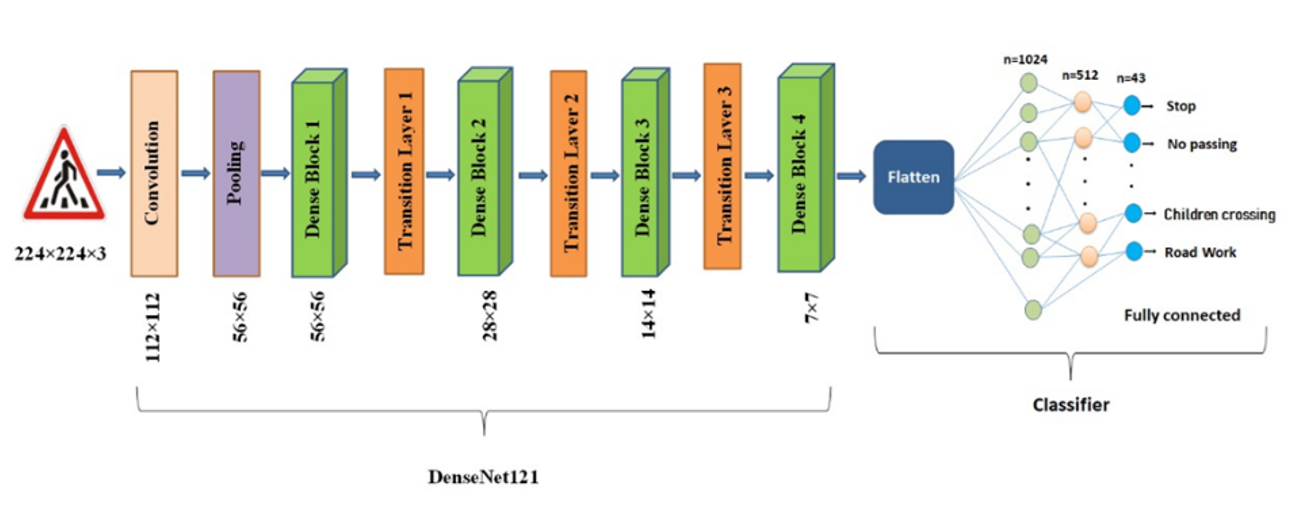
Precise classification of traffic signs is a basic and intrinsic element in the development of autonomous driving and intelligent transportation systems. This is due to its outstanding role in reducing traffic accidents and improving road safety. But the problem revolves around the difference and variation in visual similarity between the categories. As well as in the photographic conditions. This makes the task more difficult for traditional models. In this paper, we present a deep learning approach that combines pre-trained deep models in high-precision feature extraction with a unified multi-layer classifier (MLP). Able to use these features very efficiently. Regarding the dataset, the proposed framework relied on the GTSRB dataset, which includes more than fifty thousand images and contains forty-three categories. Subsequently, a standardized preprocessing operation is performed, including image normalization and resizing according to ImageNet values. This research uses several diverse deep learning models, including DenseNet121, GoogleNet, ResNet18, ResNet50, MobileNetV2, VGG19, and EfficientNet-B1, to extract high-precision features. Performance is evaluated using the following metrics: accuracy, recall, precision, and F1-score. The study concluded that using DensNet121 features with the proposed classifier we used in our research paper achieved an accuracy of 99.41%, surpassing many previous studies. The results demonstrate that the proposed model not only achieves outstanding performance but also effectively balances high accuracy and computational efficiency, making the model practically in autonomous driving environments.
Downloads
References
[1] Y. Zhu and W. Q. Yan, “Traffic sign recognition based on deep learning,” Multimedia Tools and Applications, vol. 81, no. 13, pp. 17779–17791, 2022, https://doi.org/10.1007/s11042-022-12163-0.
[2] X. R. Lim, C. P. Lee, K. M. Lim, T. S. Ong, A. Alqahtani, and M. Ali, “Recent advances in traffic sign recognition: approaches and datasets,” Sensors, vol. 23, no. 10, p. 4674, 2023, https://doi.org/10.3390/s23104674 .
[3] M.Drobiniak, S. Subbotin, D. Borovyk, and T. Kolpakova, “Traffic Sign Recognition for Advanced Driver Assistance Systems: A Neural Network and Computer Vision Approach,” International Journal of Computing, Mar. 2025. [Online].Available:https://www.researchgate.net/publication/390519351_Traffic_Sign_Recognition_for_Advanced_Driver_Assistance_Systems_A_Neural_Network_and_Computer_Vision_Approach.
[4] Z. Lian, Q. Zeng, W. Wang, D. Xu, W. Meng, and C. Su, “Traffic sign recognition using optimized federated learning in internet of vehicles,” IEEE Internet of Things Journal, vol. 11, no. 4, pp. 6722–6729, 2023, https://doi.org/10.1109/JIOT.2023.3312348.
[5] W. Wei, L. Zhang, K. Yang, J. Li, N. Cui, Y. Han, and K. Wang, “A lightweight network for traffic sign recognition based on multi-scale feature and attention mechanism,” Heliyon, vol. 10, no. 4, 2024, https://doi.org/10.1016/j.heliyon.2024.e26182.
[6] I. Benfaress, A. Bouhoute, and A. Zinedine, “Advancing Traffic Sign Recognition: Explainable Deep CNN for Enhanced Robustness in Adverse Environments,” Computers, vol. 14, no. 3, p. 88, 2025, https://doi.org/10.3390/computers14030088.
[7] R. Suresha and N. Manohar, “Two-Stage Traffic Sign Classification System,” Procedia Computer Science, vol. 235, pp. 2703–2715, 2024, https://doi.org/10.1016/j.procs.2024.04.255.
[8] P. Demokri Dizji, S. Joudaki, and H. Kolivand, “A new traffic sign recognition technique taking shuffled frog-leaping algorithm into account,” Wireless Personal Communications, vol. 125, no. 4, pp. 3425–3441, 2022, https://doi.org/10.1007/s11277-022-09718-7.
[9] P. A. Adithyan, N. Aji, S. S. Jacob, K. Joy, and R. R. Meckamalil, “Traffic Sign Recognition using HIICNN Stack Ensemble Method.”, https://doi.org/10.22214/ijraset.2024.62033.
[10] T .S . Tsoi and C. Wheelus , "Traffic Signal Classification With Cost-Sensitive Deep Learning Models,"in 2020 IEEE International Conference on Knowledge Graph (ICKG),Boca Raton,Florida,USA,2020,pp.586-592, https://doi.org/10.1109/ICBK50248.2020.00088.
[11] S. J. Solomon Jonah and S. Orike, "Traffic Sign Classification Comparison Between Various Convolution Neural Network Models," International Journal of Scientific & Engineering Research (IJSER), vol. 12, no. 7, pp. 165-171, Jul. 2021. [Online].Available:https://www.researchgate.net/publication/353287272_Traffic_Sign_Classification_Comparison_Between_Various_Convolution_Neural_Network_Models.
[12] H. Fu and H. Wang, "Traffic sign classification based on prototypes," in Proc. 16th Int. Conf. Intelligent Systems and Knowledge Engineering (ISKE), Nov. 2021, pp. 7–10, https://doi.org/10.1109/ISKE54062.2021.9755432.
[13] W. S. Lim, A. F. A. Nasir, M. A. M. Razman, A. P. A. Majeed, N. S. Kamarudin, and M. Z. Toh, "Traffic sign classification using transfer learning: An investigation of feature-combining model," Mekatronika: Journal of Intelligent Manufacturing and Mechatronics, vol. 3, no. 2, pp. 37–41, 2021, https://doi.org/10.15282/mekatronika.v3i2.7346.
[14] A. A. Sikander and H. Ali, "Image classification using CNN for traffic signs in Pakistan," arXiv preprint arXiv:2102.10130, 2021.
[15] Y. Chew, Z. Zulkoffli, Y. Chu, M. A. Ilyas, M. K. A. Khan, C. K. Ang, and L. Hong, "Malaysia traffic signs classification and recognition using CNN method," in Applied Mathematics, Modeling and Computer Simulation, IOS Press, 2022, pp. 961–969, https://doi.org/10.3233/ATDE221120.
[16]S.M. Ali, A. Mahmud, A. I. K. Khan Turja, and T. F. Arid, “Improving CNN results via KNN for Chinese Traffic Sign Recognition,” B.S. thesis, Dept. Comput. Sci. Eng., BRAC University, Dhaka, Bangladesh, Sep. 2022.
[17] X. R. Lim, C. P. Lee, K. M. Lim, and T. S. Ong, "Enhanced traffic sign recognition with ensemble learning," Journal of Sensor and Actuator Networks, vol. 12, no. 2, p. 33, 2023, https://doi.org/10.3390/jsan12020033.
[18] M. A. Khan, H. Park, and J. Chae, "A lightweight convolutional neural network (CNN) architecture for traffic sign recognition in urban road networks," Electronics, vol. 12, no. 8, p. 1802, 2023, https://doi.org/10.3390/electronics12081802.
[19] M. A. Sayeed, M. S. Islam, M. B. Islam, P. K. Pareek, and T. I. Rohan, "Bangladeshi traffic sign recognition and classification using CNN with different kinds of transfer learning through a new (BTSRB) dataset," in Proc. 2023 Int. Conf. Distributed Computing and Electrical Circuits and Electronics (ICDCECE), Apr. 2023, pp. 1–5, https://doi.org/10.1109/ICDCECE57866.2023.10151254.
[20] L. Vieira, "Comparing performance of preprocessing techniques for traffic sign recognition using a HOG-SVM," arXiv preprint arXiv:2504.09424, 2025, https://doi.org/10.48550/arXiv.2504.09424.
[21] Y. An, C. Yang, and S. Zhang, "A lightweight network architecture for traffic sign recognition based on enhanced LeNet-5 network," Frontiers in Neuroscience, vol. 18, p. 1431033, 2024, https://doi.org/10.3389/fnins.2024.1431033.
[22] S. Mingwin, Y. Shisu, Y. Wanwag, and S. Huing, "Revolutionizing traffic sign recognition: Unveiling the potential of vision transformers," arXiv preprint arXiv:2404.19066, 2024, https://doi.org/10.48550/arXiv.2404.19066.
[23] D. Williams, "Advancing road sign recognition in autonomous vehicles through convolutional neural networks: Methods and outcomes," Journal of Computer Science and Software Applications, vol. 4, no. 4, pp. 26–33, 2024.
[24] M. A. Khan and H. Park, "Exploring explainable artificial intelligence techniques for interpretable neural networks in traffic sign recognition systems," Electronics, vol. 13, no. 2, p. 306, 2024, https://doi.org/10.3390/electronics13020306.
[25] A. A. Khalifa, W. M. Alayed, H. M. Elbadawy, and R. A. Sadek, "Real-time navigation roads: Lightweight and efficient convolutional neural network (LE-CNN) for Arabic traffic sign recognition in intelligent transportation systems (ITS)," Applied Sciences, vol. 14, no. 9, p. 3903, 2024, https://doi.org/10.3390/app14093903.
[26] T. Lin, “Comparative Analysis of Deep Learning Models for Efficient Traffic Sign Recognition,” Applied and Computational Engineering, vol. 125, pp. 247-253, Mar. 2025. DOI: 10.54254/2755-2721/2025.21282. Available: https://www.researchgate.net/publication/389523965_Comparative_Analysis_of_Deep_Learning_Models_for_Efficient_Traffic_Sign_Recognition.
[27] C. Mai, "The Application of Deep Learning Algorithms in Traffic Sign Recognition," in Proceedings of the 3rd International Conference on Software Engineering and Machine Learning, 2025, https://doi.org/10.54254/2755-2721/2025.24721.
[28] Y. Chen, "Traffic sign recognition in rainy conditions based on federated learning," in ITM Web of Conferences, vol. 70, p. 01017, EDP Sciences, 2025, https://doi.org/10.1051/itmconf/20257001017.
[29] Y. Zhang, X. Luo, C. Tao, B. Qin, A. Yang, and F. Cao, "LieCConv: An image classification algorithm based on Lie group convolutional neural network," Neural Processing Letters, vol. 57, no. 1, p. 22, 2025, https://doi.org/10.1007/s11063-024-11691-0.
[30] A. A. Alemu and M. A. Widneh, "Ethiopian traffic sign recognition using customized convolutional neural networks and transfer learning," Journal of Advanced Transportation, vol. 2025, no. 1, p. 9971499, 2025, https://doi.org/10.1155/atr/9971499.
Downloads
Published
Issue
Section
License
Copyright (c) 2026 Iraqi Journal for Applied Science

This work is licensed under a Creative Commons Attribution 4.0 International License.
Licenses and Copyright
The copyright of this article is retained by the author(s).
This article is published by the Iraqi Journal for Applied Science (IJAS) under the Creative Commons Attribution 4.0 International License (CC BY 4.0).
This license permits unrestricted use, distribution, reproduction, adaptation, and reuse of the work in any medium or format, including commercial use, provided that appropriate credit is given to the original author(s) and the source, a link to the license is provided, and any modifications are indicated.
Authors retain full copyright of their work and grant IJAS a non-exclusive license to publish, archive, preserve, and disseminate the article, including registration of metadata and Digital Object Identifiers (DOIs) through Crossref.
Any third-party material included in this article remains subject to its respective copyright and licensing conditions. Authors are responsible for obtaining all necessary permissions for such material before publication.
For complete details regarding copyright, licensing, permissions, and reuse, please refer to the journal's Copyright and Licensing Policy available on the IJAS website.
License: https://creativecommons.org/licenses/by/4.0/
How to Cite