Genetic Algorithms: Evolution, Current State, And Development Prospects
DOI:
https://doi.org/10.69923/sz8a4k98Keywords:
genetic algorithms, evolutionary computation, bibliometric analysis, optimization, artificial intelligence, energy systems, trends.Abstract
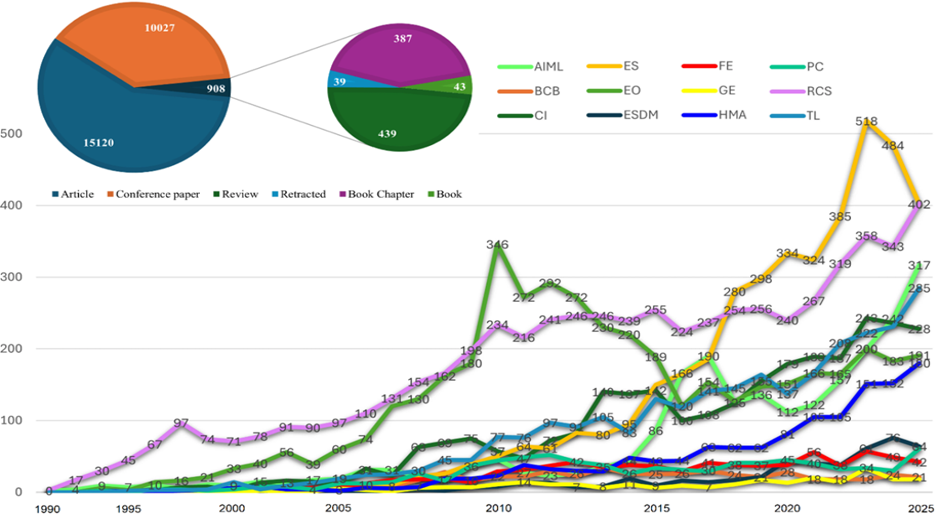
Over the past fifty years, genetic algorithms have progressed from theoretical applications to powerful engines in inferential optimization, machine learning, and cybersecurity systems. This paper presents an explanation of the improved performance of genetic algorithms based on bibliometric research of over 26,700 research papers indexed in Scopus, Web of Science, and IEEE Explore databases, covering a fifty-year period up to 2025. The study identifies key developmental stages, presents current research areas, and outlines the future of algorithms. It also highlights a shift in global leadership: during the last decade of the 20th century, the United States and the United Kingdom dominated, while in the last ten years, China has risen to prominence, accounting for over 40% of research output, with countries like India and Iran emerging as among the most productive. The research discusses the dynamics of 12 applied fields, with the highest growth rates officially recorded in 2020 in power systems, robotics, and artificial intelligence applications. This study reveals emerging trends, including the convergence of genetic algorithms with deep learning and machine learning, their integration with swarm intelligence, and their applications in sustainable energy and edge computing. It also highlights differentiable variables arising from quantum mechanics. These findings can provide a roadmap for researchers seeking to further develop and use genetic algorithms in considering rapid technological advancements.
Downloads
References
[1] Holland J.H. Adaptation in Natural and Artificial Systems. – Ann Arbor: University of Michigan Press, 1975. – 183 p.
[2] Goldberg D.E. Genetic algorithms in search, optimization, and machine learning. – Reading: Addison-Wesley, 1989. – 412 p.s. DOI: 10.5860/choice.27-0936
[3] Michalewicz Z. Genetic algorithms + data Structures = evolution programs. – 3rd ed. – Berlin: Springer, 1996. – 387 p. doi.org/10.1007/978-3-662-03315-9
[4] Deb K. An efficient constraint handling method for genetic algorithms // Computer Methods in Applied Mechanics and Engineering. – 2000. – Vol. 186, No. 2-4. – P. 311-338. DOI: 10.1016/S0045-7825(99)00389-8
[5] Srinivas N., Deb K. Multiobjective optimization using nondominated sorting in genetic algorithms // Evolutionary Computation. – 1994. – Vol. 2, No. 3. – P. 221-248. doi.org/10.1162/evco.1994.2.3.221
[6] Fonseca C.M., Fleming P.J. Genetic Algorithms for Multiobjective Optimization: Formulation, Discussion and Generalization // Proceedings of the 5th International Conference on Genetic Algorithms. – San Mateo: Morgan Kaufmann, 1993. – P. 416-423.
[7] Marler R.T., Arora J.S. Survey of multi-objective optimization methods for engineering // Structural and Multidisciplinary Optimization. – 2004 – Vol. 26, No. 6. – P. 369-395. doi.org/10.1007/s00158-003-0368-6
[8] Konak A., Coit D.W., Smith A.E. Multi-objective optimization using genetic algorithms: A tutorial // Reliability Engineering & System Safety. – 2006. – Vol. 91, No. 9. – P. 992-1007. DOI: 10.1016/j.ress.2005.11.018
[9] Davis L. Genetic Algorithms and Simulated Annealing. – London: Pitman Publishing, 1987. – 216 p.
[10] Van Eck N.J., Waltman L. Software survey: VOSviewer, a computer program for bibliometric mapping // Scientometrics. – 2010. – Vol. 84, No. 2. – P. 523-538. doi.org/10.1007/s11192-009-0146-3
[11] Bukhtiar S., Ahmed F., Naeem M. A genetic algorithm-based wrapper approach for feature selection using LSTM for electric load forecasting // Energies. – 2018. – Vol. 11, No. 10. – P. 2678.
[12] Ellefsen A.L., Æsøy V., Ushakov S., Zhang H. Remaining useful life predictions for turbofan engine degradation using semi-supervised deep learning // IEEE Access. – 2019. – Vol. 7. – P. 89128-89144.
[13] Awad M., Khanna R. Efficient learning machines: Theories, concepts, and applications for engineers and System designers. – Berkeley: Apress, 2015. – 268 p.s. doi.org/10.1007/978-1-4302-5990-9
[14] Liu H., Li J., Ge S., He H. A review of genetic algorithms in hybrid electric vehicle energy management // IEEE Transactions on Vehicular Technology. – 2020. – Vol. 69, No. 8. – P. 8148-8163.
[15] Patel B.K., Patel S.K., Patel R.B. A genetic algorithm-based reactive navigation for mobile robots // Robotics and Autonomous Systems. – 2019. – Vol. 115. – P. 1-16.
[16] Hammad M., Maher A., Wang K., Jiang F., Amrani M. Genetic algorithm-based feature selection for ECG classification // Biomedical Signal Processing and Control. – 2021. – Vol. 66. – P. 102466.
[17] Abduljabbar R., Dia H., Liyanage S., Bagloee S.A. Applications of genetic algorithms in transportation: A review // Journal of Traffic and Transportation Engineering. – 2019. – Vol. 7, No. 3. – P. 321-340.
[18] Dominguez-Navarro J.A., Dufo-López R., Yusta-Loyo J.M., Artal-Sevil J.S., Bernal-Agustín J.L. Design of an electric vehicle fast-charging station with integration of renewable energy and energy storage // Energy. – 2019. – Vol. 174. – P. 337-349. doi.org/10.1016/j.ijepes.2018.08.001
[19] Gramatica P., Cassani S., Sangion A. Genetic algorithm for descriptor selection in QSAR modeling // Journal of Chemical Information and Modeling. – 2013. – Vol. 53, No. 8. – P. 1992-2004.
[20] Sohail A., Arif F., Khan A., et al. Hybrid genetic algorithms in bioinformatics: A comprehensive review // Archives of Computational Methods in Engineering. – 2023 – Vol. 30, No. 2. – P. 1234-1256.
Downloads
Published
Issue
Section
Categories
License
Copyright (c) 2026 Omar Al-dulaimi (Author)

This work is licensed under a Creative Commons Attribution 4.0 International License.
Licenses and Copyright
The copyright of this article is retained by the author(s).
This article is published by the Iraqi Journal for Applied Science (IJAS) under the Creative Commons Attribution 4.0 International License (CC BY 4.0).
This license permits unrestricted use, distribution, reproduction, adaptation, and reuse of the work in any medium or format, including commercial use, provided that appropriate credit is given to the original author(s) and the source, a link to the license is provided, and any modifications are indicated.
Authors retain full copyright of their work and grant IJAS a non-exclusive license to publish, archive, preserve, and disseminate the article, including registration of metadata and Digital Object Identifiers (DOIs) through Crossref.
Any third-party material included in this article remains subject to its respective copyright and licensing conditions. Authors are responsible for obtaining all necessary permissions for such material before publication.
For complete details regarding copyright, licensing, permissions, and reuse, please refer to the journal's Copyright and Licensing Policy available on the IJAS website.
License: https://creativecommons.org/licenses/by/4.0/
How to Cite