An Explainable Rule-Based Framework for Knowledge Extraction and Legal Knowledge Graph Construction from Arabic Higher Education Legislation
DOI:
https://doi.org/10.69923/5hdbsy35Keywords:
Knowledge graph, Knowledge Extraction, NLPAbstract
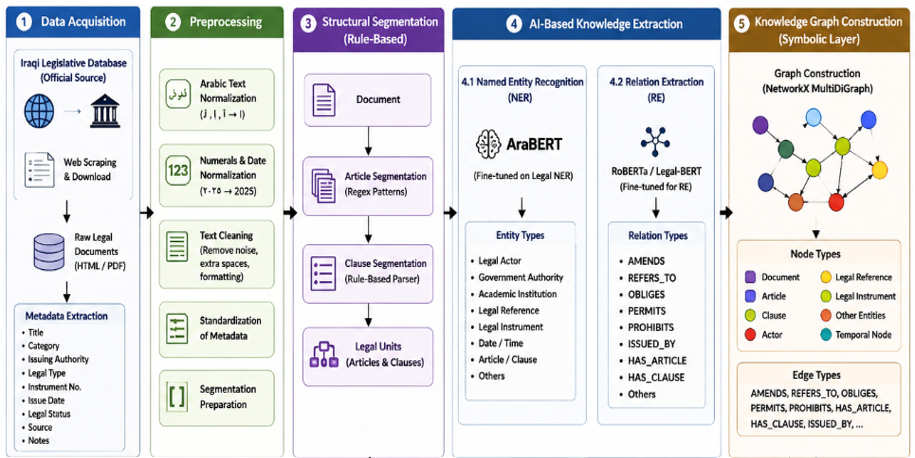
The volume and complexity of legislative documents are increasing and have significant challenges for legal information management, retrieval, and intelligent decision support. Thus, the technologies related to natural language processing (NLP) and knowledge graph (KG) were used to improve the knowledge extraction in scientific and general domain text but are limited in Arabic legal documents. This limitation is evident in higher education legislation, where these documents have hierarchical structure, frequent changes, extensive cross-references, and special terminology. All of these factors make automated interpretation and knowledge extraction complicated. This work presents an automated framework for constructing an interpretable legal knowledge schema from the Iraqi Ministry of Higher Education legislation, using transparent information extraction based on Python. This framework was developed using a legislative dataset comprising 1930 regulations, laws, ministerial directives, and administrative decisions issued by the ministry of higher education between 1970 and 2025. The proposed work integrates legislative metadata with the full text of the article through many stages of pipelining, like document prepressing, segmentation into article and clause, legal entity identification, relegation extraction, and automatic graph construction. The resultant graph provides a structured representation of legislative knowledge that supports legal search, analysis, and exploration and serves as a foundational resource for future graph retrieval-augmented generation (GraphRAG) systems and legal question-answering applications. We conducted experiments on the complete legislative corpus, producing a legal knowledge graph comprising 10,312 article units, 16,597 clauses, 510 normalized entity nodes, and 12,289 extracted relation records.
Downloads
References
[1] C. d’Amato, G. Rubini, F. Didio, D. Francioso, F. Z. Amara, and N. Fanizzi, “Automated creation of the legal knowledge graph addressing legislation on violence against women: Resource, methodology and lessons learned,” arXiv preprint arXiv:2508.06368, 2025. DOI: 10.48550/arXiv.2508.06368.
[2] S. Sirmokadam and S. Shahi, “A framework for analyzing legal documents by leveraging knowledge graphs,” in Data Management, Analytics and Innovation (2024), Lecture Notes in Networks and Systems, Springer Nature Singapore, 2024, pp. 417–425. DOI: 10.1007/978-981-97-3245-6_28.
[3] X. Zhu, H. Li, and T. Su, “Autonomous complex knowledge mining and graph representation through natural language processing and transfer learning,” Automation in Construction, vol. 155, Art. no. 105074, 2023. DOI: 10.1016/j.autcon.2023.105074.
[4] J. Li, L. Qian, P. Liu, and T. Liu, “Construction of legal knowledge graph based on knowledge-enhanced large language models,” Information, vol. 15, no. 11, Art. no. 666, 2024. DOI: 10.3390/info15110666.
[5] H. de Martim, “An ontology-driven Graph RAG for legal norms: A hierarchical, temporal, and deterministic approach,” in Legal Knowledge and Information Systems: JURIX 2025, 2025, pp. 282–287. DOI: 10.3233/FAIA251598.
[6] J. Chung, R. Ko, W. Yoo, M. Onizuka, S. Kim, T.-W. Kim, and W.-Y. Shin, “GraphCompliance: Aligning policy and context graphs for LLM-based regulatory compliance,” arXiv preprint arXiv:2510.26309, 2025. DOI: 10.48550/arXiv.2510.26309.
[7] I. Baimuratov and D. Turygin, “Representing normative regulations in OWL DL for automated compliance checking supported by text annotation,” arXiv preprint arXiv:2504.05951, 2025. DOI: 10.48550/arXiv.2504.05951.
[8] H. de Martim, “Deterministic legal agents: A canonical primitive API for auditable reasoning over temporal knowledge graphs,” arXiv preprint arXiv:2510.06002, 2025. DOI: 10.48550/arXiv.2510.06002.
[9] R. C. Barron et al., “Bridging legal knowledge and AI: Retrieval-augmented generation with vector stores, knowledge graphs, and hierarchical non-negative matrix factorization,” arXiv preprint arXiv:2502.20364, 2025. DOI: 10.48550/arXiv.2502.20364.
[10] E. Horner, C. Mateis, G. Governatori, and A. Ciabattoni, “Toward robust legal text formalization into defeasible deontic logic using LLMs,” arXiv preprint arXiv:2506.08899, 2025, doi: 10.48550/arXiv.2506.08899.
[11] E. Horner, C. Mateis, G. Governatori, and A. Ciabattoni, “Toward robust legal text formalization into defeasible deontic logic using LLMs,” arXiv preprint arXiv:2506.08899, 2025. DOI: 10.48550/arXiv.2506.08899.
[12] Iraqi Legislative Database, Supreme Judicial Council, Iraq, “Iraqi Legislative Database,” [Online]. Available: Iraqi Legislative Database. [Accessed: Aug. 31, 2026].
[13] "https://github.com/ghassankhazal79/LegalGRaph," [Online].
[14] X. Kang, L. Qu, L.-K. Soon, Z. Li, and A. Trakic, “Automating IRAC analysis in Malaysian contract law using a semi-structured knowledge base,” Artificial Intelligence and Law, 2025. DOI: 10.1007/s10506-025-09467-5.
[15] A. De Santis, M. Balduini, F. De Santis, A. Proia, A. Leo, M. Brambilla, and E. Della Valle, “Integrating large language models and knowledge graphs for extraction and validation of textual test data,” in The Semantic Web – ISWC 2024, Lecture Notes in Computer Science, vol. 15233, Springer, 2024, pp. 304–323. DOI: 10.1007/978-3-031-77847-6_17.
Downloads
Published
Issue
Section
Categories
License
Copyright (c) 2026 Ghassan (Author)

This work is licensed under a Creative Commons Attribution 4.0 International License.
Licenses and Copyright
The copyright of this article is retained by the author(s).
This article is published by the Iraqi Journal for Applied Science (IJAS) under the Creative Commons Attribution 4.0 International License (CC BY 4.0).
This license permits unrestricted use, distribution, reproduction, adaptation, and reuse of the work in any medium or format, including commercial use, provided that appropriate credit is given to the original author(s) and the source, a link to the license is provided, and any modifications are indicated.
Authors retain full copyright of their work and grant IJAS a non-exclusive license to publish, archive, preserve, and disseminate the article, including registration of metadata and Digital Object Identifiers (DOIs) through Crossref.
Any third-party material included in this article remains subject to its respective copyright and licensing conditions. Authors are responsible for obtaining all necessary permissions for such material before publication.
For complete details regarding copyright, licensing, permissions, and reuse, please refer to the journal's Copyright and Licensing Policy available on the IJAS website.
License: https://creativecommons.org/licenses/by/4.0/
How to Cite