Molecular Investigation of the Type VI Secretion System via the vgrG Gene among Multidrug-Resistant Uropathogenic Escherichia coli
DOI:
https://doi.org/10.69923/25008028Keywords:
UPEC Enterobacteriaceae T-Kit Antibiotics T6SS vgrGAbstract
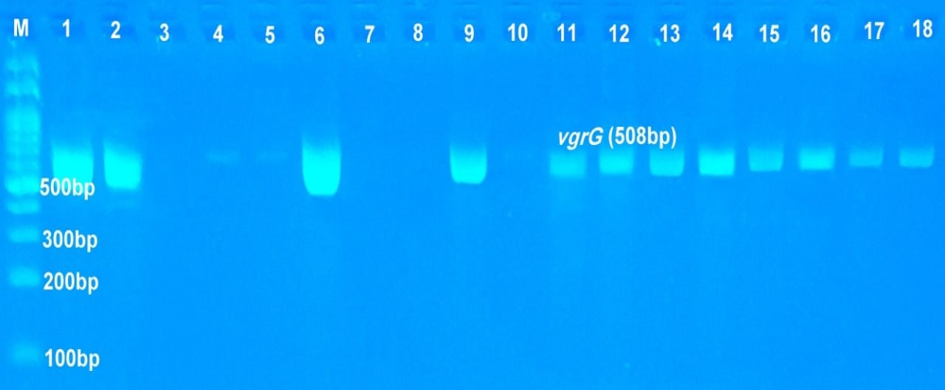
Bacteria possessing T6SS are highly pathogenic, as the system delivers effector proteins and toxins into host cells. This study aimed to determine whether UPEC strains possess this system by detecting the vgrG gene. This study involved the collection of 378 urine samples between November 2025 and February 2026. The samples were collected in the college laboratory. Antibiotic susceptibility testing was performed, and the vgrG gene was detected. E. coli isolates were identified using the Enterobacteriaceae T-Kit, yielding 82 isolates. Antibiotic susceptibility test results are Ampicillin (95.1%), Cefuroxime (85.37%), Cefotaxime (82.93%), Nalidixic acid (78.05%), Trimethoprim-sulfamethoxazole (76.83%), Trimethoprim (75.61%), Amoxicillin-clavulanate (74.4%), Ampicillin-sulbactam (71.95%), Cefoxitin (71.95%), Levofloxacin (68.29%), Cefazolin (67.07%), Ceftazidime (67.07%), Doxycycline (65.85%), Ciprofloxacin (63.41%), Cefepime (59.76%), Nitrofurantoin (29.27%), Aztreonam (52.44%), Gentamicin (45.12%), Minocycline (43.90%), Mecillinam (37.8%), Tobramycin (36.59%), Kanamycin (32.93%), Piperacillin-tazobactam (30.49%), Fosfomycin (25.61%), Amikacin (28.05%), Polymyxin B (23.2%), Ertapenem (20.73%), Imipenem (19.51%), and Meropenem (17.07%).The results also showed that, among the 44 isolates selected for detection of the vgrG gene, 37 isolates (84.1%) carried this gene.This study concludes that the UPEC bacteria in the sample under investigation pose a growing clinical threat characterized by a dual complexity: the widespread prevalence of the T6SS coincides with an alarming rise in resistance rates to conventional antibiotics.
Downloads
References
[1] Mancuso, G., Midiri, A., Gerace, E., Marra, M., Zummo, S., & Biondo, C. (2023). Urinary tract infections: The current scenario and future prospects. Pathogens, 12(4), Article 623. https://doi.org/10.3390/pathogens12040623
[2] Whelan, S., Lucey, B., & Finn, K. (2023). Uropathogenic Escherichia coli (UPEC)-associated urinary tract infections: The molecular basis for challenges to effective treatment. Microorganisms, 11(9), 2169. https://doi.org/10.3390/microorganisms11092169
[3] Maurizi, L., Musleh, L., Brunetti, F., Conte, A. L., Riccioli, A., Sideri, S., Ammendolia, M. G., Uccelletti, D., Schifano, E., De Angelis, M., Ianiro, G., Niro, A., Cutone, A., Conte, M. P., & Longhi, C. (2025). Uropathogenic Escherichia coli (UPEC) that hides its identity: features of LC2 and EC73 strains from recurrent urinary tract infections. BMC Microbiology, 25(1), 547. https://doi.org/10.1186/s12866-025-04287-8
[4] Etebu, E., & Arikekpar, I. (2016). Antibiotics: Classification and mechanisms of action with emphasis on molecular perspectives. International Journal of Applied Microbiology and Biotechnology Research, 4, 90-101. https://doi.org/10.1016/j.ijambr.2016.10.001
[5] Haddad, M. F., Abdullah, B. A., Al Obeidi, H. A., Saadi, A. M., & Haddad, M. F. (2024). Antibiotic classification, mechanisms, and indications: A review. International Journal of Medical and All Body Health Research, 5(3), 39-46. https://doi.org/10.54660/IJMBHR.2024.5.3.39-46
[6] Green, E. R., & Mecsas, J. (2016). Bacterial secretion systems – An overview. Microbiology Spectrum, 4(1), VMBF-0012-2015. https://doi.org/10.1128/microbiolspec.VMBF-0012-2015
[7] Jamali, H., Akrami, F., Layeghkhavidaki, H., & Bouakkaz, S. (2025). Bacterial protein secretion systems: Mechanisms, functions, and roles in virulence. Microbial Pathogenesis, 206, 107790. https://doi.org/10.1016/j.micpath.2025.107790
[8] Mohsin, S. M., Al-Ethari, A. Y. H., Abbas, Z. H., & Alkhfaji, K. M. S. (2025). Bacterial secretion systems: Mechanisms, functions and biomedical applications. Journal of Kerbala University, 22(1), 1. https://journals.uokerbala.edu.iq/index.php/UOKJ
[9] Navarro-Garcia, F., Ruiz-Perez, F., Larzábal, M., & Cataldi, A. (2016). Secretion systems of pathogenic Escherichia coli. In A. G. Torres (Ed.), Escherichia coli in the Americas (pp. 221–245). Springer International Publishing. https://doi.org/10.1007/978-3-319-45092-6_10
[10] Sinha, A., & Singh, R. P. (2026). Bacterial type VI secretion system augments resistance against biotic and abiotic stress. BIO Web of Conferences, 233, 02002. https://doi.org/10.1051/bioconf/202623302002
[11] Singh, R. P., & Kumari, K. (2023). Bacterial type VI secretion system (T6SS): an evolved molecular weapon with diverse functionality. Biotechnology Letters, 45(3), 309–331. https://doi.org/10.1007/s10529-023-03354-2
[12] Uchida, K., Leiman, P. G., Arisaka, F., & Kanamaru, S. (2014). Structure and properties of the C-terminal β-helical domain of VgrG protein from Escherichia coli O157. Journal of Biochemistry, 155(3), 173–182. https://doi.org/10.1093/jb/mvt109
[13] Morello, J. A., Mizer, H. E., & Granato, P. A. (2006). Laboratory manual and workbook in microbiology (8th ed.). McGraw-Hill Higher Education.
[14] Hancock, R. E. W., & Chapple, D. S. (1999). Peptide antibiotics. Antimicrobial Agents and Chemotherapy, 43(6), 1317–1323. https://doi.org/10.1128/aac.43.6.1317
[15] Al-Arosi, A. H., & Al-Mahbashi, A. A. ( 2026 ) . Molecular characterization of virulence genes among ESBL producing uropathogenic Escherichia coli in Sana a city , Yemen . Journal of Pure and Applied Microbiology, 20(2), 1801–1809. https://doi.org/10.22207/JPAM.20.2.69
[16] Akan , A., Yildirim , S. C., Avsar , C., & Yegin, Z. ( 2026 ). Prevalence, antibiotic resistance, and virulence gene profiles of uropathogenic Escherichia coli (UPEC) isolated from raw milk: implications for public health. Folia Microbiologica. https://doi.org/10.1007/s12223-026-01461-x
[17] Asgari, B., Burke, J. R., Quigley, B. L., Bradford, G., Hatje, E., Kuballa, A., & Katouli, M. (2024). Identification of virulence genes associated with pathogenicity of translocating Escherichia coli with special reference to the Type 6 secretion system. Microorganisms, 12(9), 1851. https://doi.org/10.3390/microorganisms12091851
Downloads
Published
License
Copyright (c) 2026 Abbas Alarnawtee (Author)

This work is licensed under a Creative Commons Attribution 4.0 International License.
Licenses and Copyright
The copyright of this article is retained by the author(s).
This article is published by the Iraqi Journal for Applied Science (IJAS) under the Creative Commons Attribution 4.0 International License (CC BY 4.0).
This license permits unrestricted use, distribution, reproduction, adaptation, and reuse of the work in any medium or format, including commercial use, provided that appropriate credit is given to the original author(s) and the source, a link to the license is provided, and any modifications are indicated.
Authors retain full copyright of their work and grant IJAS a non-exclusive license to publish, archive, preserve, and disseminate the article, including registration of metadata and Digital Object Identifiers (DOIs) through Crossref.
Any third-party material included in this article remains subject to its respective copyright and licensing conditions. Authors are responsible for obtaining all necessary permissions for such material before publication.
For complete details regarding copyright, licensing, permissions, and reuse, please refer to the journal's Copyright and Licensing Policy available on the IJAS website.
License: https://creativecommons.org/licenses/by/4.0/
How to Cite