Zinc Oxide Nanoparticle Biosynthetic Preparation Effect on One Virulence Resistance Mechanism in Clinical Pseudomonas aeruginosa Isolates
DOI:
https://doi.org/10.69923/d4ka6874Keywords:
Nanoparticles , Gene Expression, Virulence GenesAbstract
The efflux pump is a mechanism for antibiotic resistance. Plant extracts and
nanoparticles (NPs) are as Suita consider as replacements for antibiotics. The
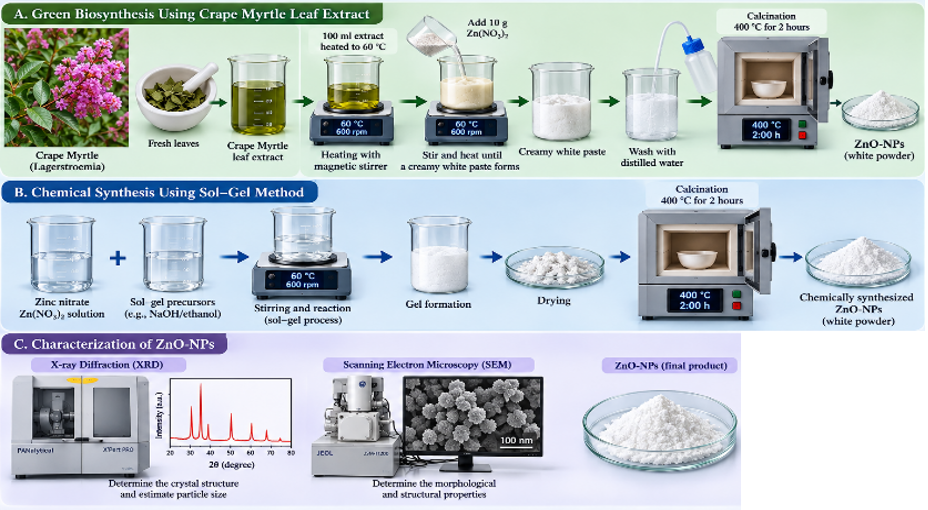
current Aim was to investigate the effect of manufactured ZnO-NPs in a
chemical way as compared to biosynthesized ZnO-NPs using plant leaves
(Crape Myrtle Lagerstroemia) successfully grown in Iraq (locally known as
"Coffee Rose (Al-Afranji)") to alter the current gene folding in MDR P.
aeruginosa isolates. P. aeruginosa was isolated and used to check the presence
or absence of the genes mexA, mexB, oprD, and oprM. Phytochemicals Present
in the extract of leaves of Lagerstroemia indica L were screened using GC
MS, whereas standard techniques were used for the analysis of ZnO-NPs. The
expression of the MexA,MexB,OprD, andOprM genes—following treatment
with zinc oxide nanoparticles—was studied using the RT-PCR technique. All
MDR isolates containedisolated contained the genes for MexA, MexB, OprD
and OprM. The extract of Lagerstroemia indica L. was found to contain active
chemical compounds by gas chromatography mass spectrometry (GC-MS).
The size of ZnO-NPs biosynthesized via a biological method was determined.
to be 19 to 57 nm, whereas the sizes of those prepared via the sol-gel method
ranged from 43 to 76 nm. When tested against multi-drug resistant (MDR)
isolates, the MIC values were 1024, 256, and 512 micrograms/mL for the
chemical preparation of ZnO-NPs, Bioengineered ZnO-NPs, and
Lagerstroemia indica L. extract, respectively.
Downloads
References
[1] C. Aloke, C. O. Egwu, O. O. Onisuru, S. Otun, and I. Achilonu, “Exploiting the therapeutic efficacy of nanoparticles in the treatment of multidrug-resistant bacteria: Excitements and pitfalls,” Journal of Drug Delivery Science and Technology, vol. 104, Art. no. 106501, 2025, doi: 10.1016/j.jddst.2024.106501.
[2] I. E. Mba and E. I. Nweze, “Nanoparticles as therapeutic options for treating multidrug-resistant bacteria: Research progress, challenges, and prospects,” World J. Microbiol. Biotechnol., vol. 37, pp. 1–30, 2021. doi: 10.1007/s11274-021-03070-x.
[3] H. Hamrayev, K. Shameli, and S. Korpayev, “Green synthesis of zinc oxide nanoparticles and its biomedical applications: A review,” J. Res. Nanosci. Nanotechnol., vol. 1, no. 1, pp. 62–74, 2021. doi: 10.37934/jrnn.1.1.6274.
[4] R. Ahmed, K. H. Manik, M. S. Islam, A. Rhine, J. J. Mim, and N. Hossain, “Green synthesis methods for nanoparticles: Principles, biological routes, and physicochemical approaches toward sustainable nanotechnology,” Next Materials, vol. 11, Art. no. 101929, Apr. 2026, doi: 10.1016/j.nxmate.2026.101929.
[5] S. Antunes Filho, M. S. dos Santos, O. A. L. dos Santos, B. P. Backx, M. L. Soran, O. Opriş, I. Lung, A. Stegarescu, and M. Bououdina, “Biosynthesis of nanoparticles using plant extracts and essential oils,” Molecules, vol. 28, no. 7, Art. no. 3060, Mar. 2023, doi: 10.3390/molecules28073060.
[6] Z. Yue, Y. Xu, M. Cai, X. Fan, H. Pan, D. Zhang, and Q. Zhang, “Floral elegance meets medicinal marvels: Traditional uses, phytochemistry, and pharmacology of the genus Lagerstroemia L.,” Plants, vol. 13, no. 21, Art. no. 3016, Oct. 2024, doi: 10.3390/plants13213016.
[7] K. S. Anandhu, M. Jose, S. Kuriakose, and P. M. Jayalakshmi, “Phytochemical analysis and in vitro antidiabetic activity of aqueous extract of Lagerstroemia speciosa and Aegle marmelos,” Research Journal of Pharmacy and Technology, vol. 14, no. 9, pp. 4697–4701, 2021, doi: 10.52711/0974-360X.2021.00816.
[8] M. Chandra, “Antimicrobial activity of different maturity of Lagerstroemia indica L. on pathogenic bacteria,” International Journal of Basic and Applied Biology, vol. 2, no. 4, pp. 213–216, 2015.
[9] K. S. Anandhu, M. Jose, S. Kuriakose, and P. M. Jayalakshmi, “Phytochemical analysis and in vitro antidiabetic activity of aqueous extract of Lagerstroemia speciosa and Aegle marmelos,” Research Journal of Pharmacy and Technology, vol. 14, no. 9, pp. 4697–4701, 2021, doi: 10.52711/0974-360X.2021.00816.
[10] A. Behera and S. Awasthi, “Anticancer, antimicrobial and hemolytic assessment of zinc oxide nanoparticles synthesized from Lagerstroemia indica,” BioNanoScience, vol. 11, no. 4, pp. 1030–1048, 2021, doi: 10.1007/s12668-021-00889-4.
[11] M. R. Arabestani, M. Rajabpour, R. Y. Mashouf, M. Y. Alikhani, and S. M. Mousavi, “Expression of efflux pump MexAB-OprM and OprD of Pseudomonas aeruginosa strains isolated from clinical samples using qRT-PCR,” Arch. Iran. Med., vol. 18, no. 2, 2015. PMID: 25644798.
[12] M. Hombach, M. Jetter, N. Blöchliger, N. Kolesnik-Goldmann, P. M. Keller, and E. C. Böttger, “Rapid disc diffusion antibiotic susceptibility testing for Pseudomonas aeruginosa, Acinetobacter baumannii and Enterococcus spp.,” Journal of Antimicrobial Chemotherapy, vol. 73, no. 2, pp. 385–391, Feb. 2018, doi: 10.1093/jac/dkx404.
[13] I. G. A. Auda, A. G. Noor Hashim, and K. Sabah Abdul Latif, “Occurrence of MexAB-OprM efflux pump operon on septicemic Pseudomonas aeruginosa chromosome,” published online, 2012. https://www.ipmj.org/journal/vol11/iss1/17
[14] A. Crabbé, P. De Boever, R. Van Houdt, H. Moors, M. Mergeay, and P. Cornelis, “Use of the rotating wall vessel technology to study the effect of shear stress on growth behavior of Pseudomonas aeruginosa PA01,” Environ. Microbiol., vol. 10, no. 8, pp. 2098–2110, 2008. DOI: 10.1111/j.1462-2920.2008.01631.x
[15] M. J. Haque, M. M. Bellah, M. R. Hassan, and S. Rahman, “Synthesis of ZnO nanoparticles by two different methods & comparison of their structural, antibacterial, photocatalytic, and optical properties,” Nano Express, vol. 1, no. 1, Art. no. 010007, 2020, doi: 10.1088/2632-959X/ab7a43.
[16] Y. J. Teh, A. Bahari Jambek, and U. Hashim, “A study of nano-biosensors and their output amplitude analysis algorithms,” J. Med. Eng. Technol., vol. 41, no. 1, pp. 72–80, 2017. doi:10.1080/03091902.2016.1223195
[17] M. J. Haque, M. M. Bellah, M. R. Hassan, and S. Rahman, “Synthesis of ZnO nanoparticles by two different methods & comparison of their structural, antibacterial, photocatalytic, and optical properties,” Nano Express, vol. 1, no. 1, Art. no. 010007, 2020, doi: 10.1088/2632-959X/ab7a43.
[18] K. J. Livak and T. D. Schmittgen, “Analysis of relative gene expression data using real-time quantitative PCR and the 2−ΔΔCT method,” Methods, vol. 25, no. 4, pp. 402–408, Dec. 2001, doi: 10.1006/meth.2001.1262.
[19] A. M. S. Almohaidi and S. M. H. Al-Shimmary, “Accurate detection of Pseudomonas aeruginosa by using specific genes,” Biochem. Cell Arch., vol. 19, no. S1, pp. 2121–2126, 2019. DOI: 10.35124/bca.2019.19.S1.2121
[20] N. Q. Abd, Evaluation of the Activity of Quinoline-2-One Derivatives as Bacterial Antibiotic to Inhibit the MexB Efflux Protein of Pseudomonas aeruginosa, M.Sc. thesis, Inst. Genetic Eng. Biotechnol., Univ. Baghdad, Baghdad, Iraq, 2018.
[21] K. Shigemura, K. Osawa, A. Kato, “Association of overexpression of efflux pump genes with antibiotic resistance in Pseudomonas aeruginosa strains clinically isolated from urinary tract infection patients,” J. Antibiot. (Tokyo), vol. 68, no. 9, pp. 568–572, 2015. Doi: 10.1038/ja.2015.34
[22] J. Singh, T. Dutta, K. H. Kim, M. Rawat, P. Samddar, and P. Kumar, “Green synthesis of metals and their oxide nanoparticles: Applications for environmental remediation,” J. Nanobiotechnol., vol. 16, no. 1, pp. 1–24, 2018. Doi: 10.1186/s12951-018-0408-4
[23] M. Naseer, U. Aslam, B. Khalid, and B. Chen, “Green route to synthesize zinc oxide nanoparticles using leaf extracts of Cassia fistula and Melia azadarach and their antibacterial potential,” Sci. Rep., vol. 10, no. 1, Art. no. 9055, 2020. Doi:10.1038/s41598-020-65949-3
[24] R. Akter, L. M. Fariha, S. Halder, S. Sharmin, E. S. Taki, I. K. Lihu, A. H. Tipu, M. M. R. M. Meem, F. A. Ripa, and S. Sharmin, “GC-MS-employed phytochemical characterization and anticancer, antidiabetic, and antioxidant activity screening of Lagerstroemia thorelli,” Chemistry & Biodiversity, vol. 21, no. 12, Art. no. e202400999, Dec. 2024, doi: 10.1002/cbdv.202400999.
[25] Z. Yue, Y. Xu, M. Cai, X. Fan, H. Pan, D. Zhang, and Q. Zhang, “Floral elegance meets medicinal marvels: Traditional uses, phytochemistry, and pharmacology of the genus Lagerstroemia L.,” Plants, vol. 13, no. 21, Art. no. 3016, Oct. 2024, doi: 10.3390/plants13213016.
[26] K. A. Cárdenas, J. Domínguez, E. Palacios, L. García, P. A. Ramírez, and M. Flores, “Synthesis and characterization of ZnO nanoparticles obtained from the extract of Schinus molle,” in Characterization of Minerals, Metals, and Materials 2021. Springer, 2021, pp. 569–575. doi:10.1007/978-3-030-65493-1_58
[27] A. Hadi, U. Nayef, F. Mutlak, M. Jabir, and M. Muayad, “Antibacterial and anticancer properties of zinc oxide nanoparticles: A review of current advances and future directions,” Journal of Applied Sciences and Nanotechnology, vol. 5, no. 3, Art. no. 5, 2025, doi: 10.53293/jasn.2025.7541.1330.
[28] K. S. Siddiqi, A. ur Rahman, Tajuddin, and A. Husen, “Properties of zinc oxide nanoparticles and their activity against microbes,” Nanoscale Research Letters, vol. 13, no. 1, Art. no. 141, May 2018, doi: 10.1186/s11671-018-2532-3.
[29] F. Y. Ahmed, U. F. Aly, R. M. Abd El-Baky, and N. G. F. M. Waly, “Effect of titanium dioxide nanoparticles on the expression of efflux pump and quorum-sensing genes in MDR Pseudomonas aeruginosa isolates,” Antibiotics, vol. 10, no. 6, Art. no. 625, 2021. DOI: 10.3390/antibiotics10060625
[30] A. Lorusso, J. A. Bittencourt Carrara, C. D. N. Barroso, F. F. Tuon, and H. Faoro, “Role of efflux pumps on antimicrobial resistance in Pseudomonas aeruginosa,” International Journal of Molecular Sciences, vol. 23, no. 24, Art. no. 15779, 2022, doi: 10.3390/ijms232415779.
[31] S. G. Ali, M. A. Ansari, M. A. Alzohairy, et al., “Effect of biosynthesized ZnO nanoparticles on multi-drug resistant Pseudomonas aeruginosa,” Antibiotics, vol. 9, no. 5, Art. no. 260, 2020. doi: 10.3390/antibiotics9050260.
[32] H. Al-Momani, D. Al Balawi, S. Hamed, B. A. Albiss, M. Almasri, H. AlGhawrie, L. Ibrahim, H. Al Balawi, S. Al Haj Mahmoud, J. Pearson, and C. Ward, “The impact of biosynthesized ZnO nanoparticles from Olea europaea (Common Olive) on Pseudomonas aeruginosa growth and biofilm formation,” Scientific Reports, vol. 13, no. 1, Art. no. 5096, Mar. 2023, doi: 10.1038/s41598-023-32-1.
[33] M. Askarinia, M. Ghaedi, L. Manzouri, S. S. Khoramrooz, A. Sharifi, G. Ghalamfarsa, R. Jannesar, F. Sadri, and S. Abdolmajid Khosravani, “The effect of Cu-BPDCA-Ty on antibacterial activity and the expression of mecA gene in clinical and standard strains of methicillin-resistant Staphylococcus aureus,” Jundishapur J. Microbiol., vol. 11, no. 3, 2018. doi: 10.5812/jjm.60680
[34] M. R. Uddin, S. Gervasoni, G. Malloci, P. Ruggerone, and H. I. Zgurskaya, “Substrate specificity checkpoints of the multidrug efflux pump MexF from Pseudomonas aeruginosa,” ACS Infectious Diseases, vol. 12, no. 2, pp. 611–622, Feb. 2026, doi: 10.1021/acsinfecdis.5c00760.
[35] K. E. Vivekanandan, P. Vinoth Kumar, R. C. Jaysree, and T. Rajeshwari, “Exploring molecular mechanisms of drug resistance in bacteria and progressions in CRISPR/Cas9-based genome expurgation solutions,” Global Medical Genetics, vol. 12, no. 2, Art. no. 100042, 2025, doi: 10.1016/j.gmg.2025.100042.
[36] H. P. Schweizer, “Efflux as a mechanism of resistance to antimicrobials in Pseudomonas aeruginosa and related bacteria: Unanswered questions,” Genet. Mol. Res., vol. 2, no. 1, pp. 48–62, 2003. PMID: 12917802.
Downloads
Published
License
Copyright (c) 2026 mohanad mahdi (Author)

This work is licensed under a Creative Commons Attribution 4.0 International License.
Licenses and Copyright
The copyright of this article is retained by the author(s).
This article is published by the Iraqi Journal for Applied Science (IJAS) under the Creative Commons Attribution 4.0 International License (CC BY 4.0).
This license permits unrestricted use, distribution, reproduction, adaptation, and reuse of the work in any medium or format, including commercial use, provided that appropriate credit is given to the original author(s) and the source, a link to the license is provided, and any modifications are indicated.
Authors retain full copyright of their work and grant IJAS a non-exclusive license to publish, archive, preserve, and disseminate the article, including registration of metadata and Digital Object Identifiers (DOIs) through Crossref.
Any third-party material included in this article remains subject to its respective copyright and licensing conditions. Authors are responsible for obtaining all necessary permissions for such material before publication.
For complete details regarding copyright, licensing, permissions, and reuse, please refer to the journal's Copyright and Licensing Policy available on the IJAS website.
License: https://creativecommons.org/licenses/by/4.0/
How to Cite