In vitro morphogenesis and conservation of the medicinal plant Vitex negundo L. through nodal explants
DOI:
https://doi.org/10.69923/bnnavj49Keywords:
Direct Organogenesis MS medium Nodal Explant Plant growth regulators RhizogenesisAbstract
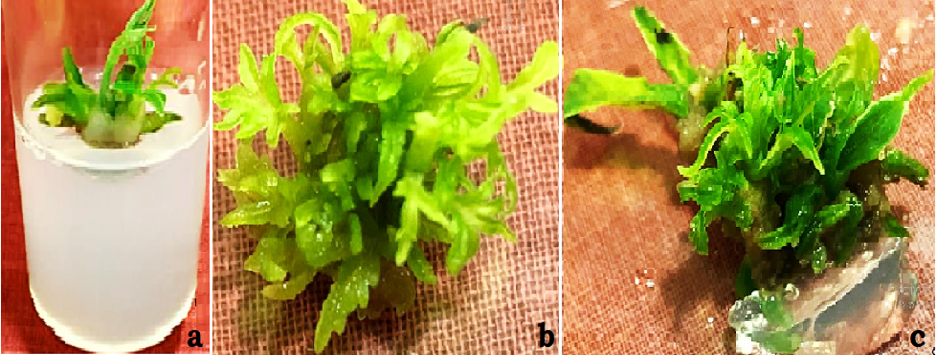
Vitex negundo L. is an important medicinal plant widely used in traditional medicine and is valued for its diverse pharmacological properties. The present study was undertaken to develop an efficient in vitro regeneration and multiplication protocol for V. negundo using nodal explants and to establish a suitable approach for ex situ conservation. Nodal explants were cultured on Murashige and Skoog (MS) medium supplemented with different concentrations of cytokinins: 6-benzylaminopurine (BAP), kinetin (KIN), and thidiazuron (TDZ), either individually or in combination with auxin indole-3-acetic acid (IAA). Among the cytokinins tested, TDZ was the most effective for shoot induction. MS medium containing 2.0 mg L⁻¹ TDZ produced 92.6% shoot induction, with an average of 10.2 shoots per explant. Further optimization using auxin–cytokinin combinations demonstrated that MS medium supplemented with 2.0 mg L⁻¹ TDZ and 0.5 mg L⁻¹ IAA was highly effective, producing up to 96.3% shoot induction and 26.6 shoots per explant. The regenerated shoots were subjected to root on half-strength MS media containing IBA. The highest rooting response was obtained on half-strength MS medium containing 0.75 mg L⁻¹ IBA, with 100% root induction, 12.8 roots per shoot, and a mean root length of 4.9 cm. The rooted plantlets were successfully hardened and acclimatized, with 100% survival reported under field conditions. The developed protocol provides an efficient method for rapid multiplication and ex situ conservation of V. negundo and may facilitate the production of quality planting material for medicinal plant cultivation.
Downloads
References
[1] S. Saikat and R. Chakraborty, “Toward the integration and advancement of herbal medicine: a focus on traditional Indian medicine,” Botanics: Targets and Therapy, Vol. 5, pp. 33-44, 2015.
[2] F. E. George, M. A. Hall and G. J. De Klerk, “Plant Propagation by Tissue Culture,” 3rd Edition, Springer, Dordrecht., 2008.
[3] C. Chandramu, R. D. Manohar, D. G. Krupadanam and R. V. Dashavantha, “Isolation, Characterization and Bio- logical Activity of Betulinic Acid and Ursolic Acid from Vitex negundo L,” Phytotherapy Research, vol. 17, no. 2, pp. 129-134, 2003.
[4] A. K. Meena, U. S. Niranjan, A. K.Yadav, B. Singh, A. K. Nagaria, A. Gaurav, M. M. Rao, “Vitex negundo L.; a Review on its Ethnobotany, Phytochemical and Pharmacological Profile,” Research J. Pharmacognosy and Phytochemistry, vol. 2, no. 2, pp. 122-128, 2010.
[5] R. Ahmed and M. Anis M, “Rapid in vitro propagation system through shoot tip cultures of Vitex trifolia L.– an important multipurpose plant of the Pacific traditional Medicine,” Physiology and Molecular Biology of Plants, vol. 20, no. 3, pp. 385-392, 2014.
[6] Y. Sahoo and P. K. Chand, “Micropropagation of Vitex negundo L., a woody aromatic medicinal shrub, through high-frequency axillary shoot proliferation,” Plant Cell Rep., vol. 18, no. 3-4, pp. 301-307, 1998.
[7] N. Ahmed and M. Anis, “Rapid clonal multiplication of a woody tree, Vitex negundo L. through axillary shoots proliferation,” Agroforest Syst., vol. 71, pp. 195–200, 2007.
[8] Amit Kumar, M. da Fayaz, M. H. Bhat and J. Ashok Kumar, “An efficient protocol for in-vitro regeneration of Vitex negundo an important medicinal plant,” Biosci. Biotech. Res. Comm., vol. 11, no. 2, pp. 256-262, 2018.
[9] G. Garg, S. Singh and S. Chaudhary, “In vitro organogenesis and high-frequency plant regeneration in Vitex negundo (L) using thidiazuron,” Plant Archives, vol. 23, no. 2, pp. 73-79, 2023.
[10] T. Murashige, and F. Skoog, “Revised Medium for Rapid Growth and Bio Assays with Tobacco Tissue Cultures,” Plant Physiology, vol. 15, pp. 473-497, 1962.
[11] A. C. Huetteman and J. E. Preece, “Thidiazuron: a potent cytokinin for woody plant tissue culture,” Plant Cell, Tissue and Organ Culture, vol. 33, pp. 105-119, 1993.
[12] N. Ahmad, M. Faisal, S. A. Hussain and M. Anis, “Regulation of morphogenesis and improvement in shoot multiplication in Vitex Species using thidiazuron,” Book Chapter: Thidiazuron: From Urea Derivative to Plant Growth Regulator, Publisher: Springer Singapore, pp. 343-349, 2018.
[13] G. J. De Klerk_, J. T. Brugge and S. Marinova, “Effectiveness of indoleacetic acid, indolebutyric acid and naphthaleneacetic acid during adventitious root formation in vitro in Malus ‘Jork 9’,” Plant Cell, Tissue and Organ Culture, vol. 49, pp. 39-44, 1997.
[14] J. Pospisilova, I. Ticha, P. Kadlecek, D. Haisel and Plzakova, “Acclimatization of micropropagated plants to ex vitro conditions,” Biologia plantarum, vol. 42, no. 4, pp. 481-497, 1999.
Downloads
Published
License
Copyright (c) 2026 Dr Subba Tata Sape, P. Sudhakara Rao (Author)

This work is licensed under a Creative Commons Attribution 4.0 International License.
Licenses and Copyright
The copyright of this article is retained by the author(s).
This article is published by the Iraqi Journal for Applied Science (IJAS) under the Creative Commons Attribution 4.0 International License (CC BY 4.0).
This license permits unrestricted use, distribution, reproduction, adaptation, and reuse of the work in any medium or format, including commercial use, provided that appropriate credit is given to the original author(s) and the source, a link to the license is provided, and any modifications are indicated.
Authors retain full copyright of their work and grant IJAS a non-exclusive license to publish, archive, preserve, and disseminate the article, including registration of metadata and Digital Object Identifiers (DOIs) through Crossref.
Any third-party material included in this article remains subject to its respective copyright and licensing conditions. Authors are responsible for obtaining all necessary permissions for such material before publication.
For complete details regarding copyright, licensing, permissions, and reuse, please refer to the journal's Copyright and Licensing Policy available on the IJAS website.
License: https://creativecommons.org/licenses/by/4.0/
How to Cite